

Overview
Session memory lets AI nodes in chat-driven workflows access previous messages from the current conversation. When enabled, FlowX automatically retrieves recent conversation history and injects it into the LLM’s context — giving the AI agent awareness of what was discussed earlier in the session. Memory is per-session (identified by Chat Session ID) and managed entirely by FlowX. You don’t need to build any memory retrieval logic — just toggle it on per node.Automatic retrieval
The recent conversation history is retrieved and attached on each message
Verbatim context
The last 30 turns are sent to the model in full, oldest to newest — no lossy summarization
Per-node control
Turn memory on per AI (Custom Agent) or Intent Classification node with the Use conversation memory toggle
Memory tab in console
Inspect the conversation context that was sent to the model in the workflow console log
How memory works
1
User sends a message
The Chat component sends the message +
chatSessionId to the chat-driven workflow.2
Memory retrieval
FlowX retrieves the recent conversation history for the session — the last 30 turns (each a user
message and the agent’s response).
3
Context injection
For each node with Use conversation memory enabled, the retrieved turns are added to the LLM
prompt in full (oldest to newest), giving the AI agent context from earlier in the session.
4
Response and storage
After the AI generates a response, FlowX stores both the user message and the agent response,
so they’re available as memory on the next message.
What gets sent to the model
When memory is enabled, the recent turns are wrapped in a<history> block and added to the prompt,
introduced as “Prior conversation between the user and the assistant (oldest to newest)”:
- The last 30 turns are included in full — there is no summarization or truncation of older turns within that window.
- A turn the user cancelled mid-response is marked as cancelled rather than dropped.
Enabling memory
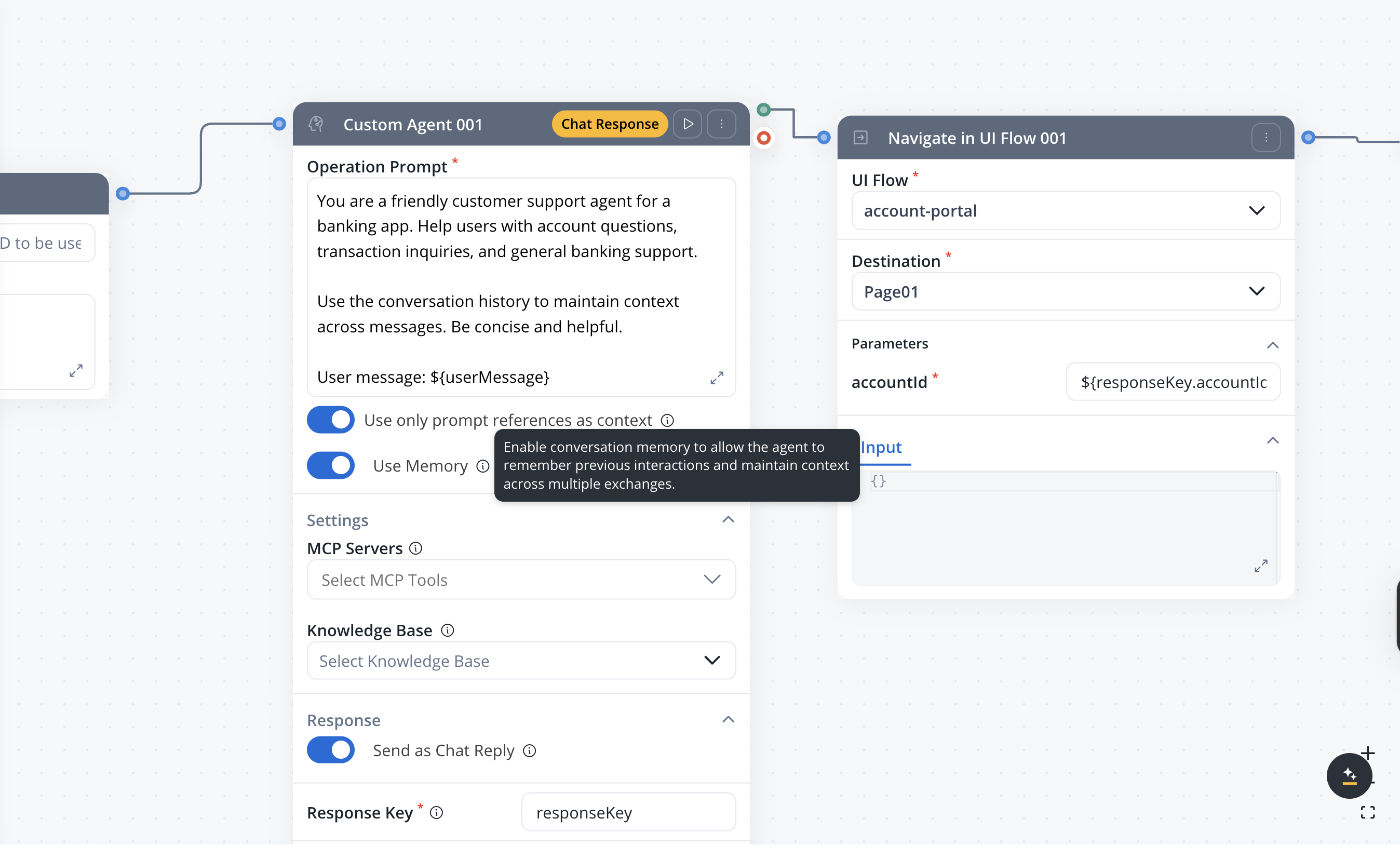
- AI (Custom Agent) nodes — for context-aware AI responses
- Intent Classification nodes — for more accurate classification using conversation history
chatSessionId with its request; FlowX retrieves the recent turns
and attaches them to the LLM call.
Inspecting memory in the console
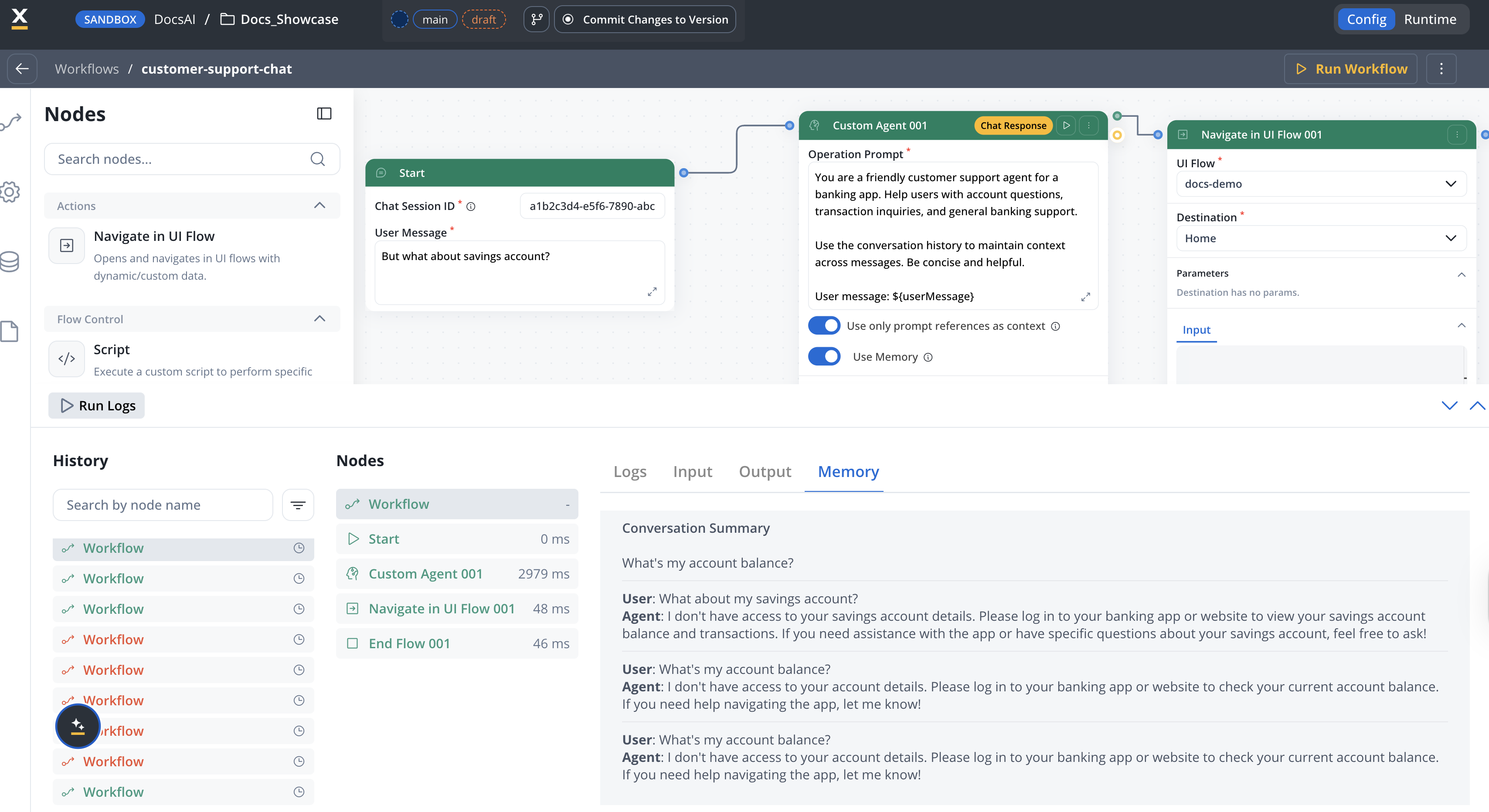
- A Conversation Summary heading followed by the conversation’s title.
- The most recent user/agent turns from the session.
memoryUseSummary object:
The Memory tab is a preview of recent turns for debugging; the
summary field carries the
conversation’s title, and chatMessages lists the most recent turns. The full set of turns sent to
the model (up to 30) is what the AI node actually receives — see What gets sent to the
model.Storage
Session memory is tied to the
chatSessionId — the same session ID retrieves the same memory across
workflow runs. The Chat component manages session IDs automatically.
Limitations
- Memory is session-scoped — there is no cross-session or cross-user memory.
- The last 30 turns are sent to the model; turns older than that window are not included.
- Memory cannot be manually edited or cleared from the Designer UI.
- Only user messages and agent responses are stored — internal workflow data is excluded.
Related resources
Chat-driven workflows
Full guide to building chat-driven workflows with memory and intent routing
Chat component
Runtime behavior, session management, and display modes
Intent Classification
Route conversations based on detected user intent with optional memory
Custom Agent node
Configure AI nodes with memory, chat reply, and response settings