

How it works
Tasks and process instances
When a process instance starts, FlowX creates one task for that instance. The task acts as a container that tracks everything happening inside the process: which swimlane the work is in, who is assigned, what stage it has reached, and what its status is. The relationship is one task per process instance, not per user or per node.Tokens and swimlanes
Inside a task, FlowX tracks individual tokens as they move through swimlanes and stages. Each time a token enters or exits a swimlane or stage, Task Management records that transition. This means a single task can reflect activity across multiple swimlanes if the process is designed that way.Parallel gateways
When a process reaches a parallel gateway and splits into multiple paths:- The parent token is paused (
ON_HOLD) while child tokens execute in parallel. - Each child token is tracked independently inside the same task.
- If multiple tokens land in the same swimlane, Task Management automatically deduplicates them so the task list shows a single entry per swimlane.
- When all parallel paths complete and the gateway joins, the parent token resumes.
Enabling task management for a process
Before Task Management can track a process, you must enable it:- In FlowX Designer, open the process definition and go to Process Settings → Task Management tab.
- Toggle Use process in task management to ON.
Key features
- Views: Configurable interfaces to display task-related data, scoped to a process definition.
- Stages: Monitor the progression of tasks within a process by identifying where a case may have stalled. Useful for tracking business stages like onboarding, verification, and validation.
- Allocation rules: Automatically distribute tasks among users based on current workload. The user with the fewest assigned tasks in the target swimlane is selected.
- Localization (Available in 5.1.1+): Multi-language support with 34+ languages. Configure substitution tags in CMS while table grid localization happens automatically. See Task Management Localization for details.
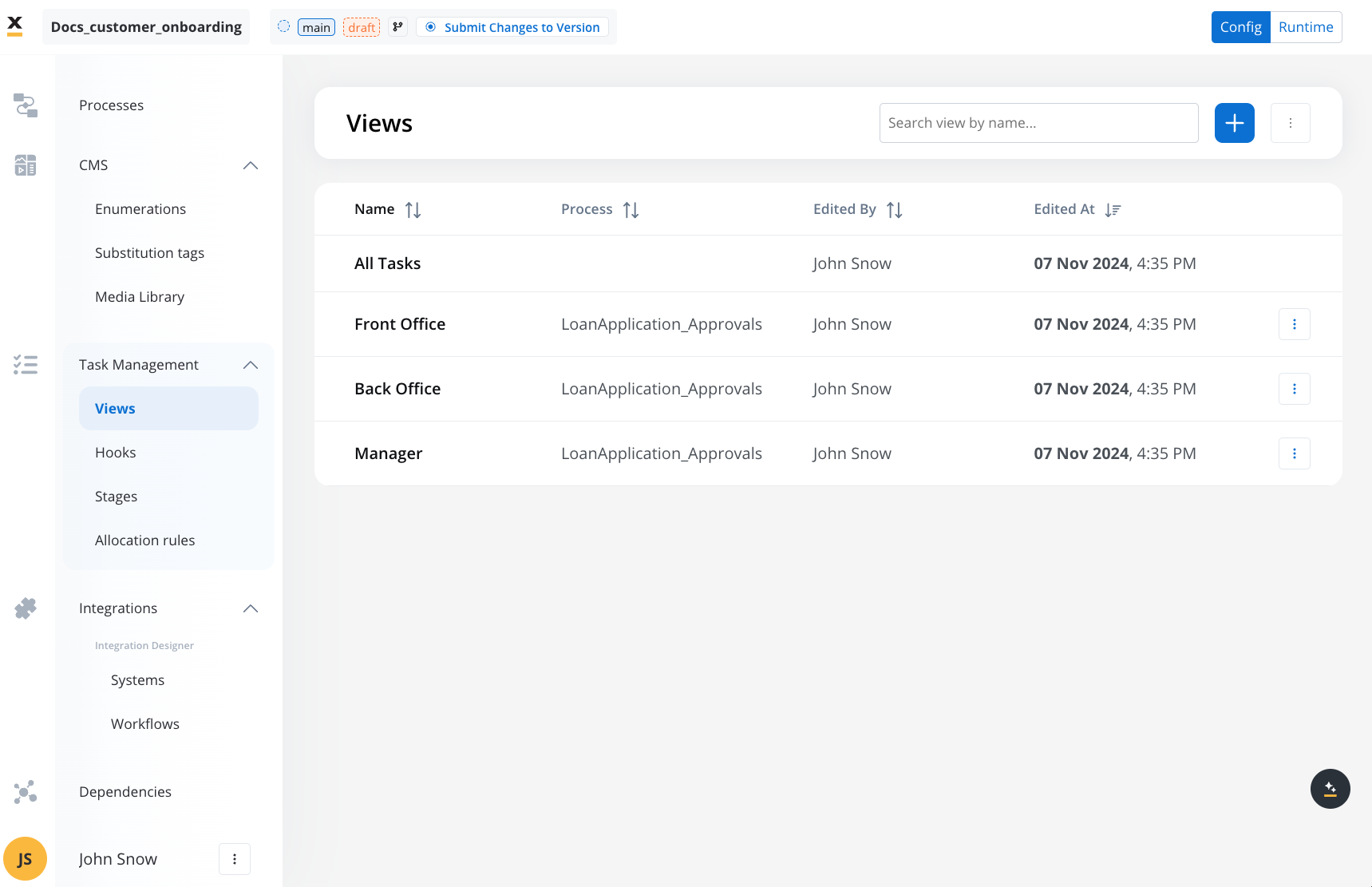
Task Management Views
Views offer a flexible way to tailor task data display according to business needs. By configuring views, users can create structured, customized interfaces that help specific roles, departments, or use cases access relevant data effectively. Example of custom view: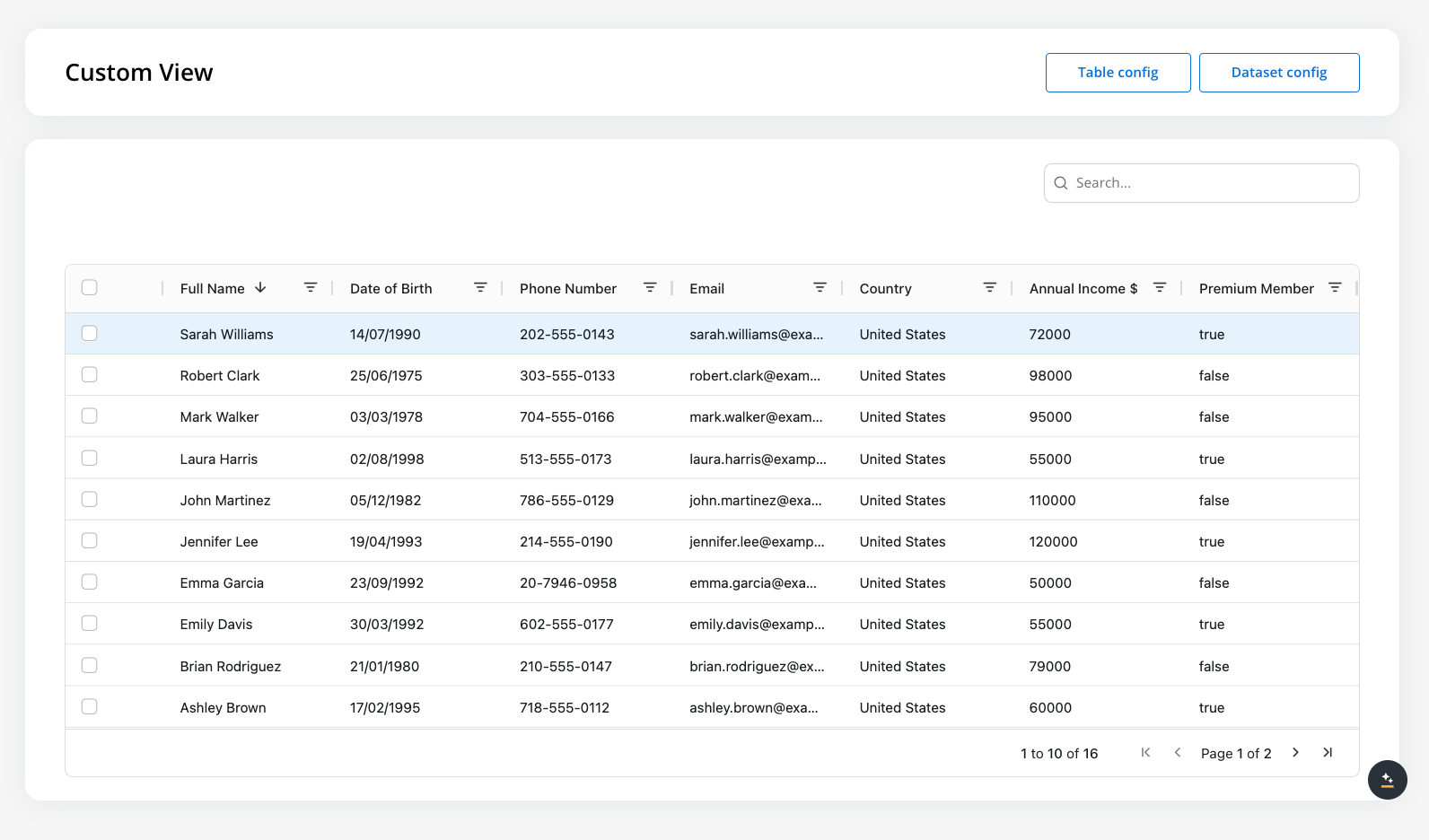
All tasks
In the All Tasks section, you can view all tasks generated from any process definition marked as “to be used in task manager” within a project. This provides a centralized view of all relevant tasks, as long as you have the appropriate permissions.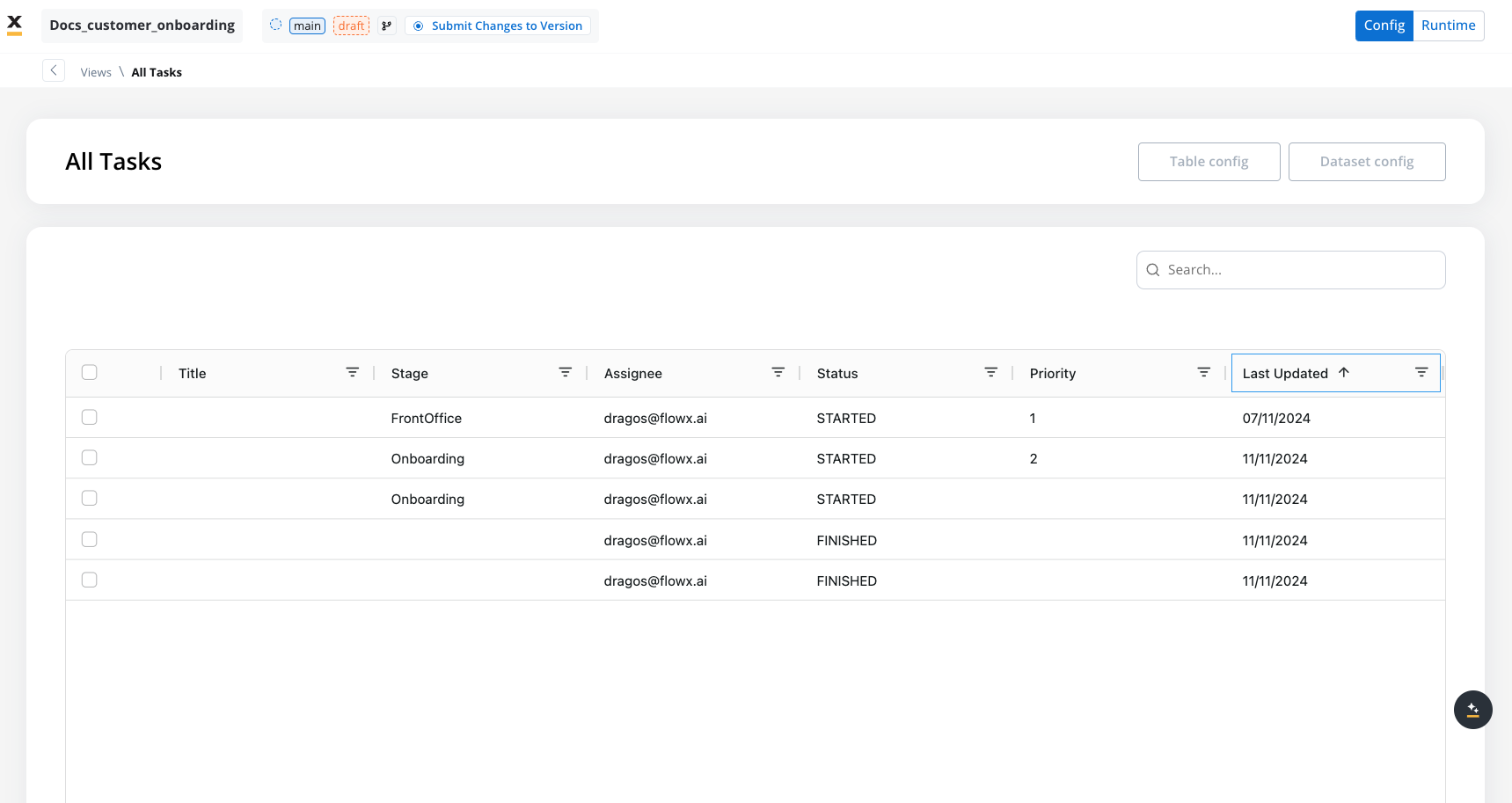
Dataset Config and Table Config options are not accessible in the All Tasks view.
Creating a view
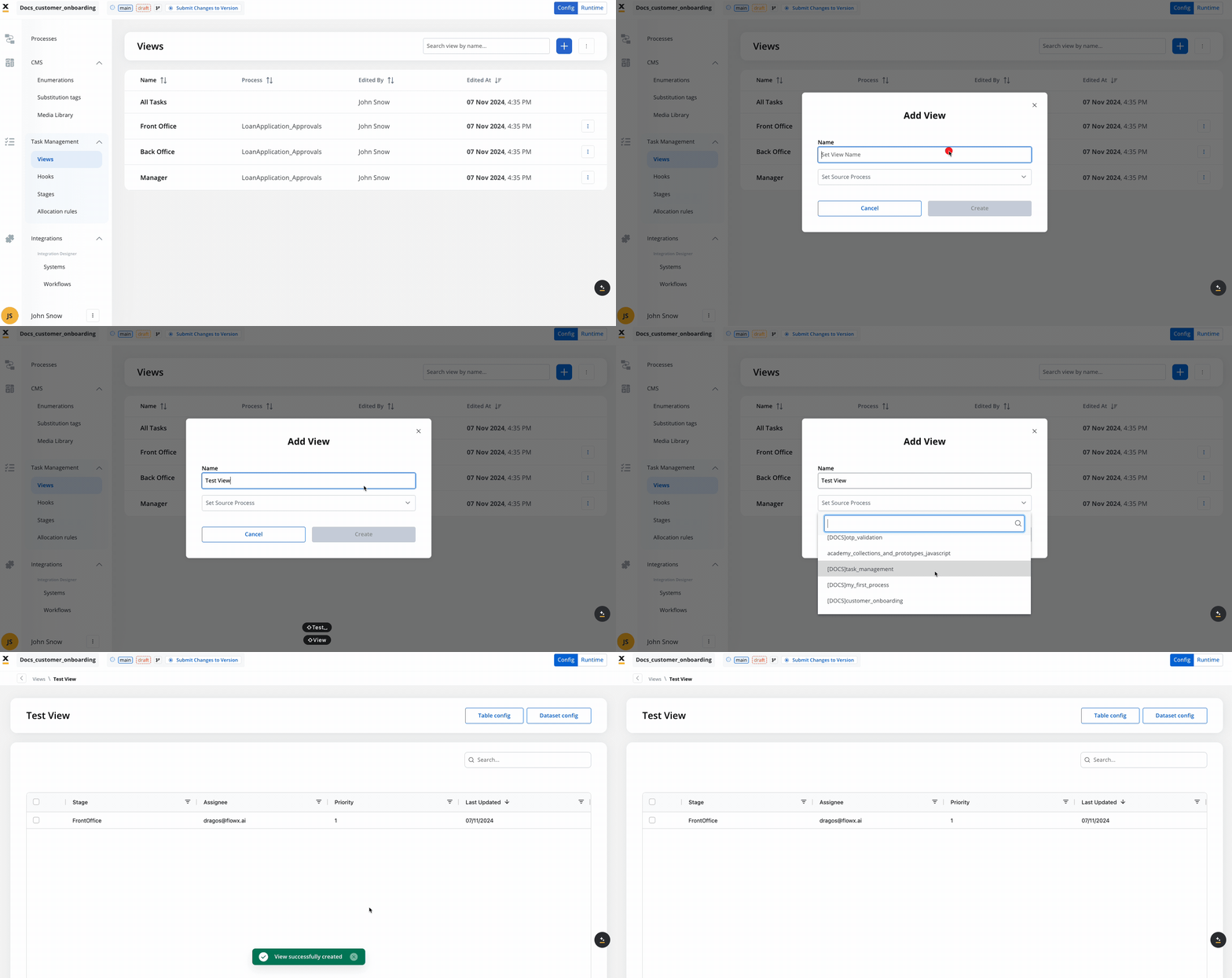
In the Views section, you can create a new view by selecting a name and choosing a process definition. The process definition is crucial because it determines which keys you can access when configuring the view. To set up a view, navigate to the Views section in the Task Management interface:- Click Add View.
- Enter a Name for the view.
- Choose a Process Definition: This will link the view’s configuration to a specific process and its associated keys.
Once a view is created for a process (e.g., Process X), it cannot be reassigned to another process. This ensures consistent data structuring based on the selected process definition.
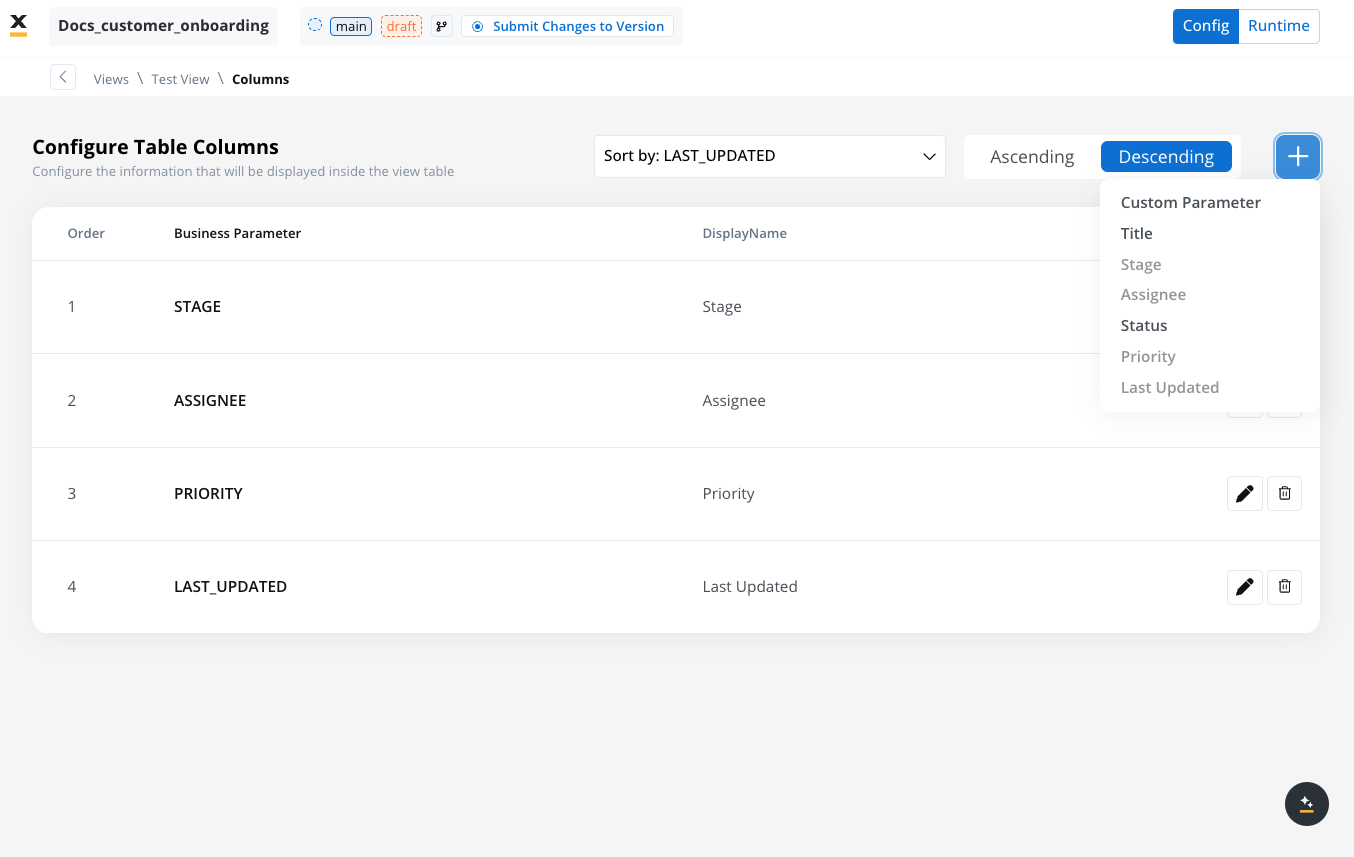
- Stage: Indicates where the process halted, providing a clear view of its current state.
- Assignee: Displays the username of the user the task is assigned to. By default, this is the
preferred_usernameclaim from the user’s identity provider token, which in Keycloak is the user’s Username field. The column doesn’t show the user’s first name, last name, or email. - Priority: A numeric value set via business rules, used for sorting and filtering tasks in views.
- Last Updated: Shows the timestamp of the most recent action taken on the task.
- Title: Displays the designated name of the task, which can be customized by using Business Rules.
- Status: The current process instance status, such as
STARTEDorFINISHED. See Process status updates for all values. - Custom parameters: User-defined keys within the process settings, which become available only after their configuration is complete.
Custom parameters and display names
Display names
You can rename default and custom parameters to make them contextually relevant for various business needs. For example:- Rename an address field to clarify if it refers to “Residence” or “Issuing Location.”
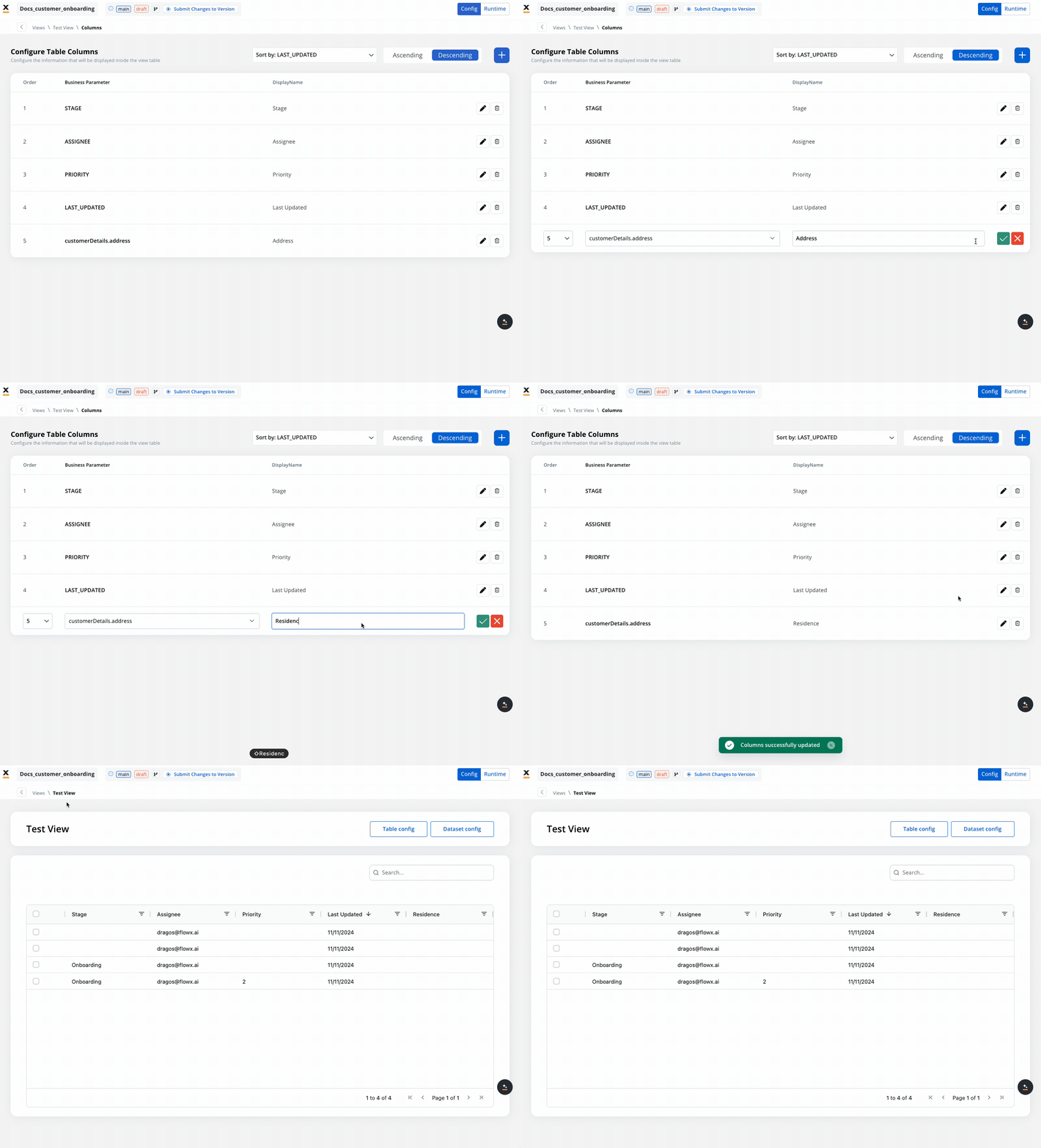
- Use Substitution Tags for dynamic display names.
Renaming a parameter’s Display Name will only change how it’s shown in the interface, without altering the actual data model. The rename option is also available for default parameters (not just custom parameters). Changing the Display Name also allows the use of Substitution Tags.For multi-language support, configure substitution tags in CMS for each language. See Task Management Localization for complete localization setup.
Custom Parameters in Task Management
Custom parameters in Task Management provide a way to tailor task displays and ensure that task data aligns with specific business needs and contexts. Key setup and configuration- Adding Custom Parameters:
- In Process Settings → Task Management, you can define the custom keys that will be indexed and made available for tasks.
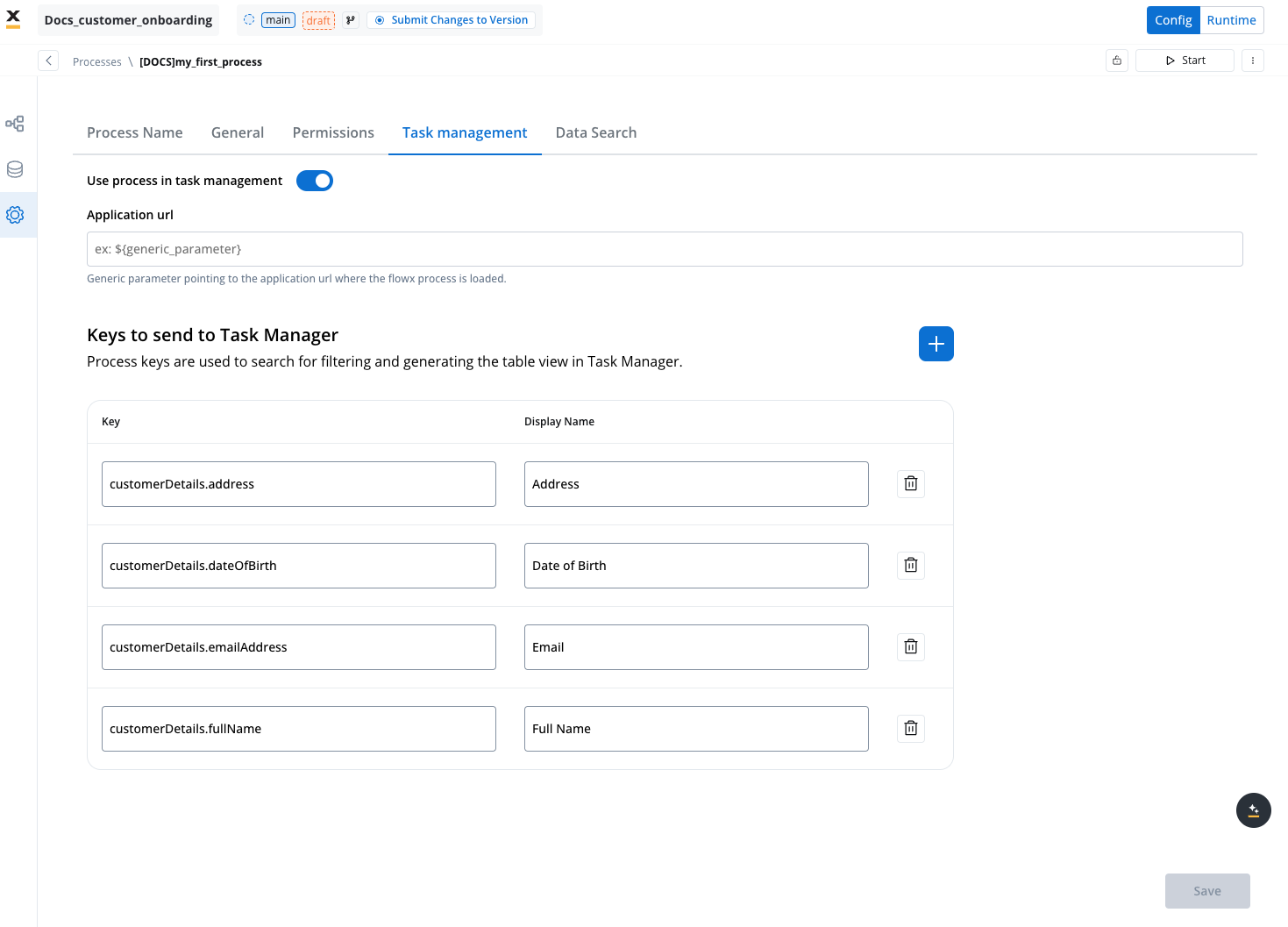
- Each custom parameter can be renamed to suit different business contexts, ensuring clarity in cases where parameters may have multiple meanings.
Ensure that the custom key exists in the Data Model before it can be mapped in Task Management.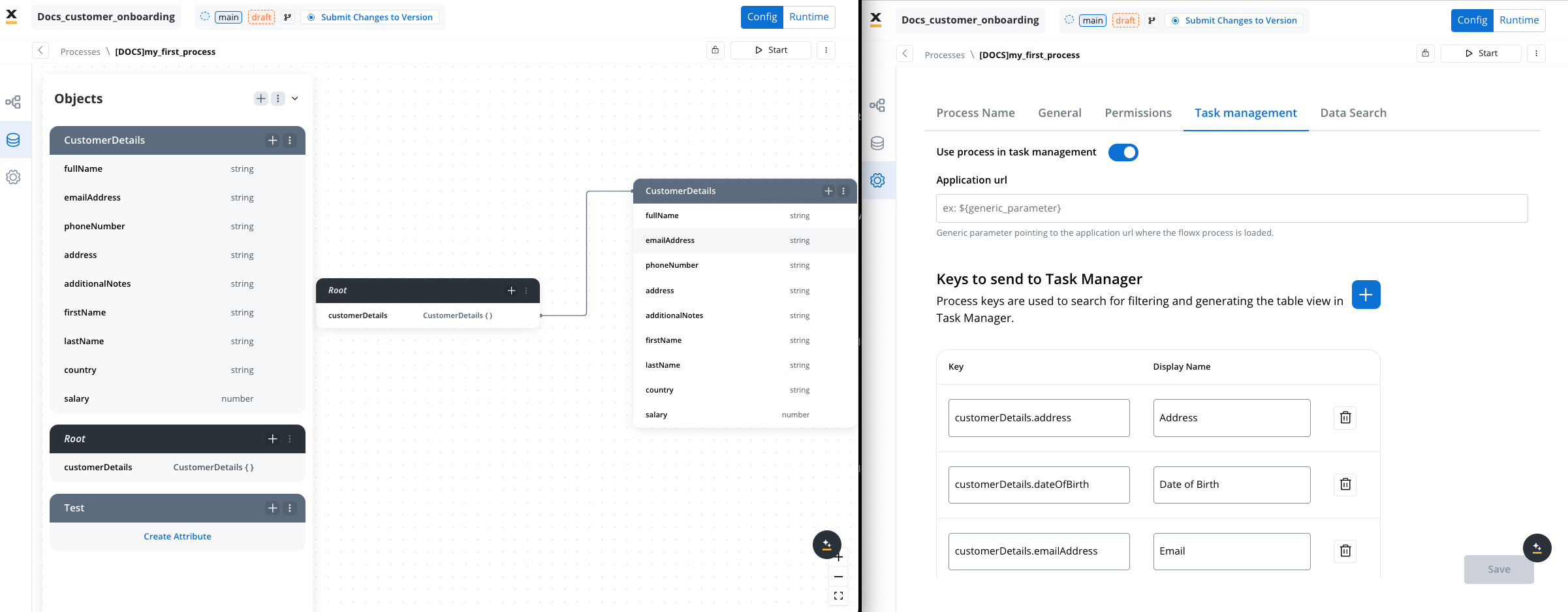
- Labeling Custom Parameters:
- When adding a custom parameter, use the rename option to assign it a label relevant to the process context (as demonstrated in the example above).
- This allows parameters to remain flexible for different roles or departments, adapting to each use case.
Remember to enable the Use process in task management toggle in Process Settings → Task Management and the Update task management switch on relevant nodes. See Enabling task management for a process for details.
Table config and Dataset config in Task Management
You can use Table Config and Dataset Config to configure and filter task data effectively. These configurations help create a customized and user-friendly interface for different roles, departments, or organizational needs.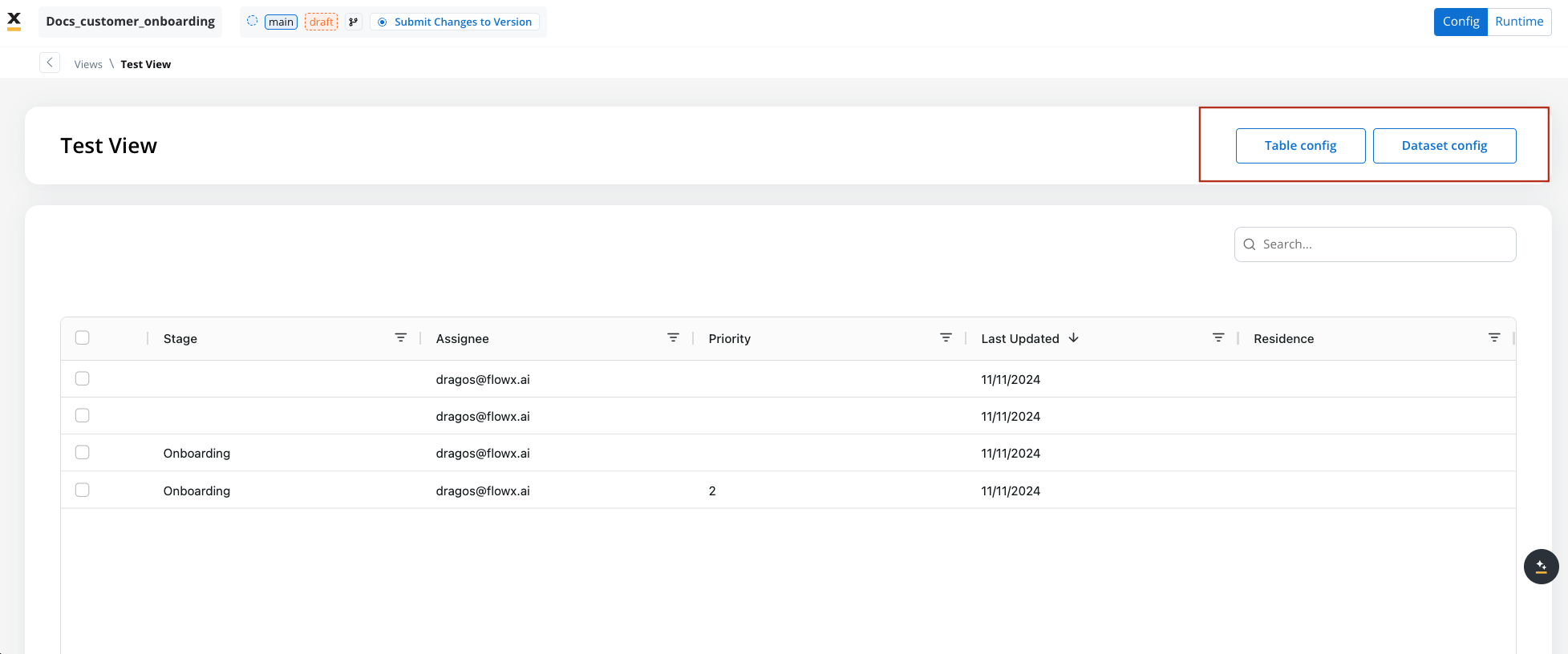
Table config
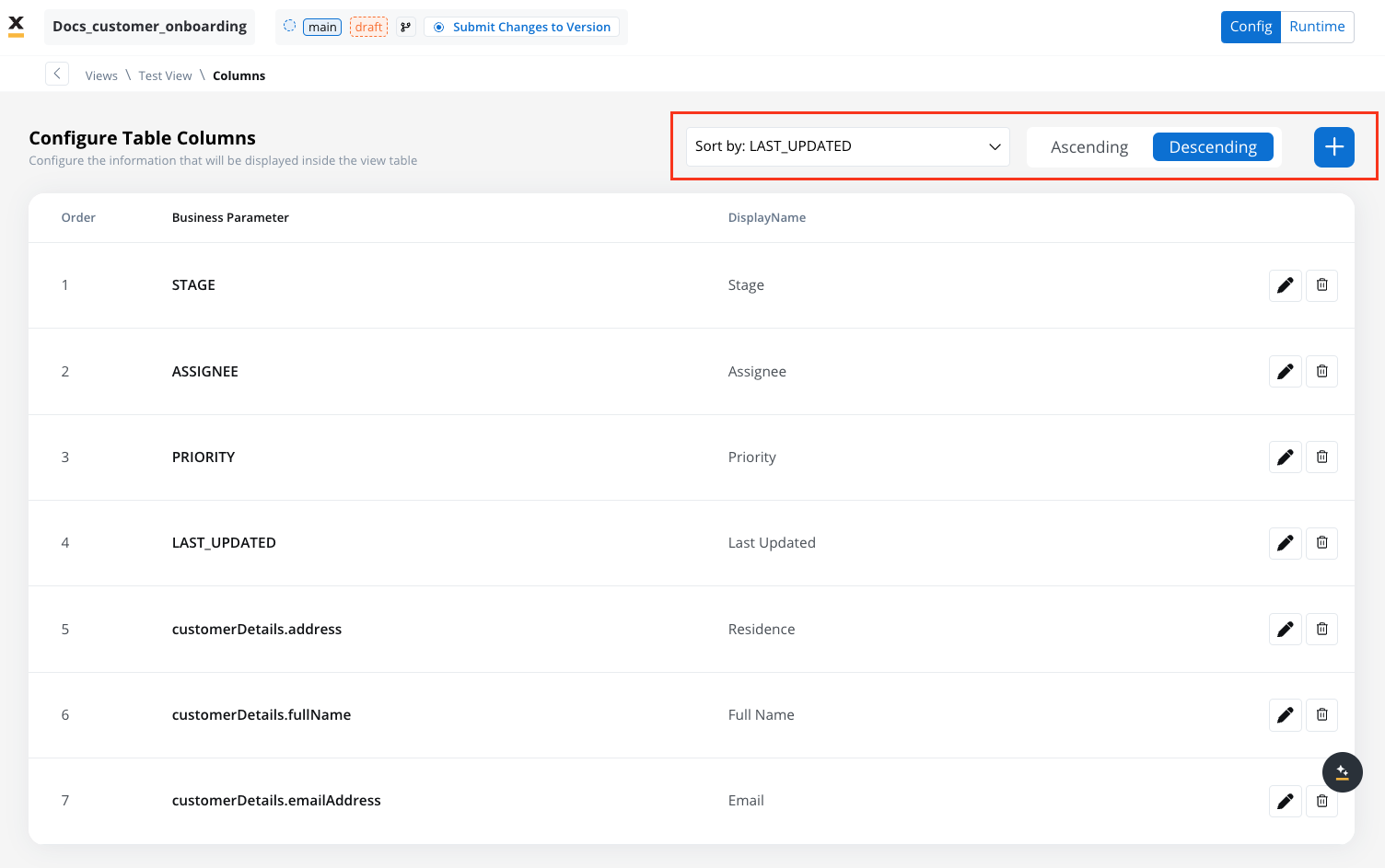
Table Config is used to define the structure and content of the Task Management table view. Here, you can configure the columns displayed in the table and set up default sorting options.-
Configuring the Table Columns:
- Default Columns: By default, the table includes the following columns: Stage, Assignee, Priority, and Last Updated.
- You can add additional columns, such as Title, Status, and Custom Parameters. Custom parameters can be chosen from the keys configured in Process Settings → Task Management.
-
Setting Default Sorting:
- You can select one column for default sorting in ascending or descending order. This configuration helps prioritize how data is initially displayed, often based on “Last Updated” or other relevant fields.
- If no specific sorting rule is configured, the table will automatically apply sorting based on the Last Updated column.
Dataset config
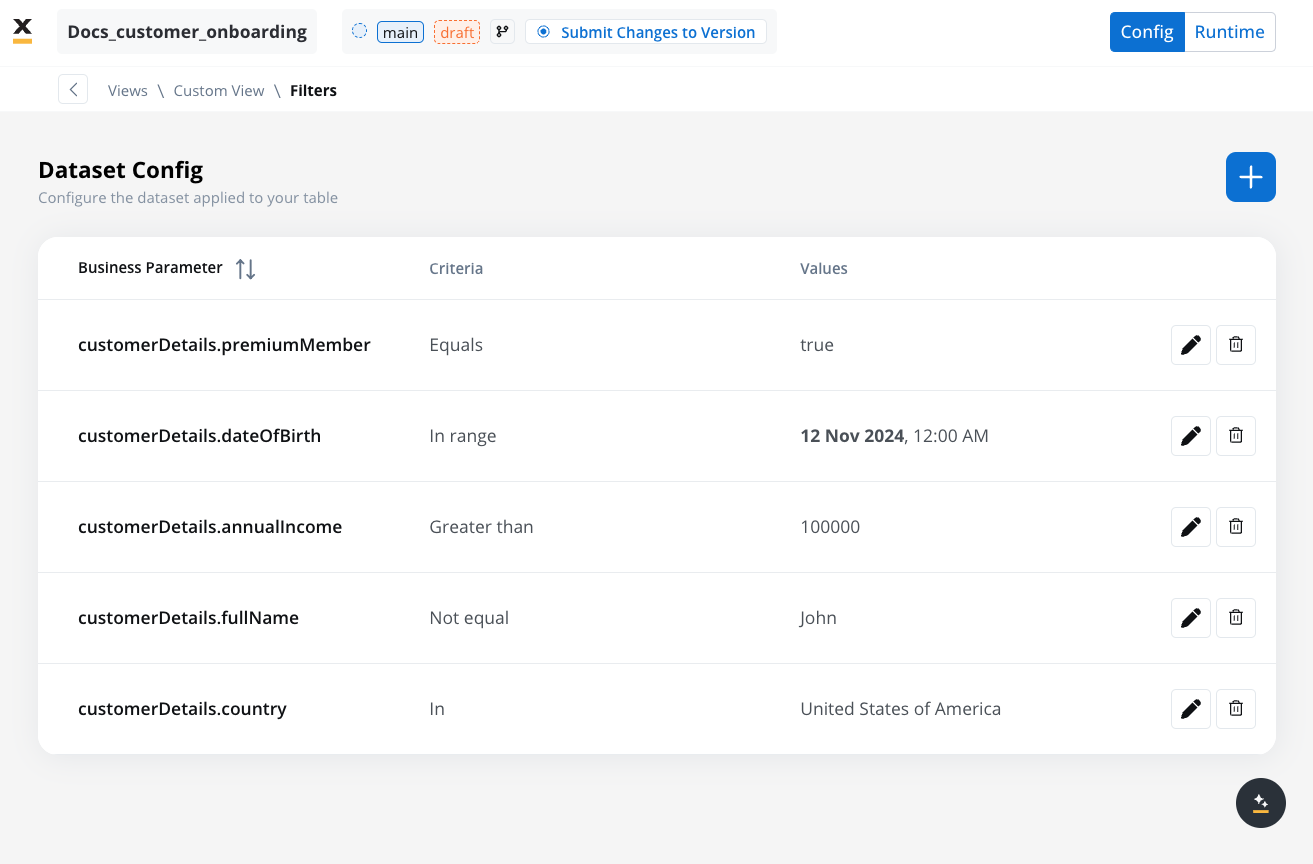
Dataset Config is used to filter and refine the data displayed in Task Management views. This helps create targeted views based on specific needs, such as differentiating data for front office vs. back office or specific roles like managers and operators.-
Adding Filters:
- You can apply filters on the keys brought into the Dataset Config to customize the data shown. Filters can be applied based on various data types, such as enums, strings, numbers, dates, and booleans.
-
Filtering Options by Data Type:
- Enums: Can be filtered using the
Inoperator. Only parent enums are available for mapping in Task Management (ensure enums are mapped in the data model beforehand).
- Enums: Can be filtered using the
Before you can map enums in Task Management, they must be configured in the Data Model. Only parent enums can be mapped.
Searching tasks
The search box in a task view matches your keyword against the visible columns of that view only. Columns you haven’t added to the view are not searched, and the search does not scan the full task payload. How the keyword matches depends on each column’s data type:- Text columns: partial, case-insensitive match. Searching
invreturns tasks whose value containsinv,INV, orInvoice. - Number columns (INTEGER, FLOAT): exact match, and only when the keyword is itself a number. A non-numeric keyword skips these columns.
- Boolean columns: exact match, only for
trueorfalse. - Date columns: not searched. Use view filters to narrow by date instead.
If a search returns fewer results than expected, check which columns the view exposes. Only visible, non-date columns are searched, so add the column you want to search on to the view, or use view filters for date and exact-value matching.
View filter operators reference
The following table provides a comprehensive reference of all available view filter operators and their compatible data types:Data type filter compatibility
String filters:Equals,Not Equals,In,Starts With,Ends With,Contains,Not Contains
Equals,Greater Than,Less Than,Greater Than or Equal,Less Than or Equal,Range
Equals,Not Equals,Greater Than,Less Than,Greater Than or Equal,Less Than or Equal,Range
Equals
In
- Role-Specific Configurations:
- Dataset Config allows creating views tailored to specific audiences, such as different departments or roles within an organization. However, note that filters in Dataset Config do not override user permissions on task visibility.
Managing data model changes
Views are scoped to a process definition and do not need to be recreated when the data model changes. However, custom parameters used as columns must exist as keys in the process’s data model before they can be added to Task Management. If you modify a custom key’s attribute type after indexing, you must re-index it in Process Settings → Task Management for the change to take effect.Task details
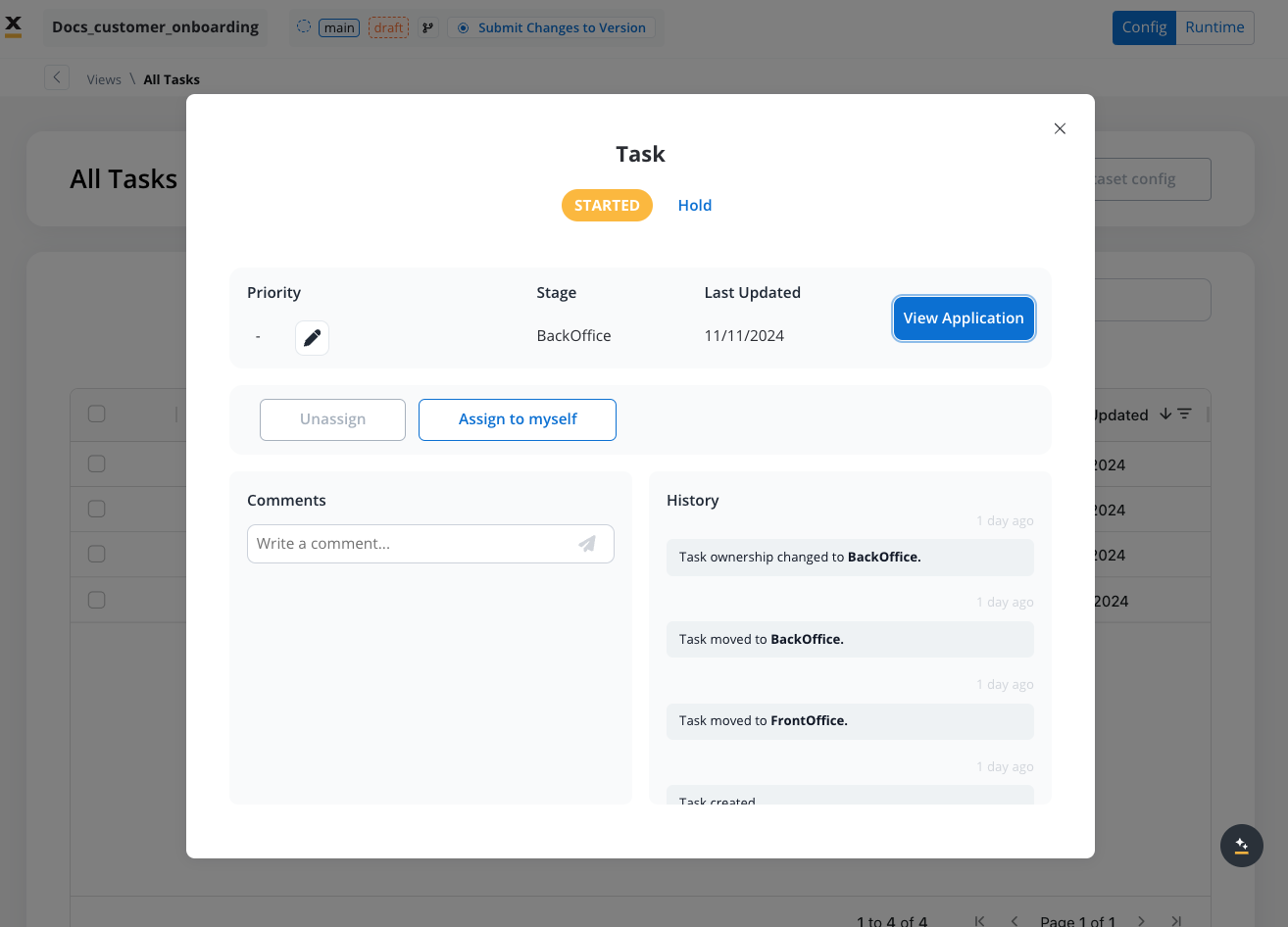
The Task Details tab within Task Manager provides key process information, including:- Priority: A numeric value (set via business rules) used for sorting and filtering tasks. Does not affect automatic allocation.
- Status: The current process instance status (for example,
STARTED,FINISHED, orON_HOLD). - Stage: The current stage during process execution.
- Comments: User comments.
- History: Information such as task creation, creator, and status changes.
- Last Updated: Displays the most recent timestamp of any changes made to a task.
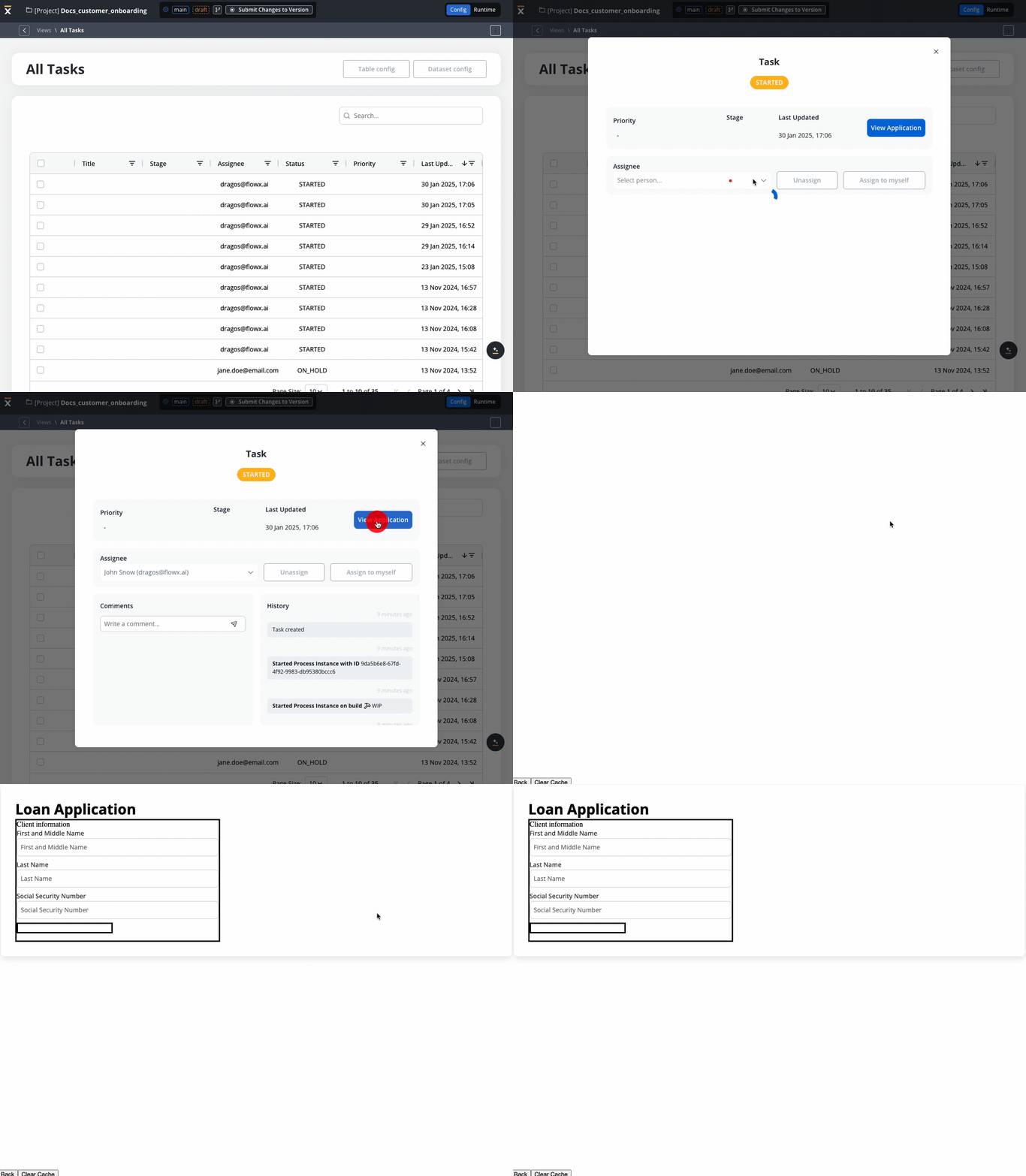
- View Application: Provides direct access to the container application URL where the FlowX.AI process related to a specific task is running.
-
Navigate to the Task Management Interface:
- Open the Task Management section within the project and select the desired View that contains the list of tasks.
-
Locate the Task:
- In the selected view (e.g., All Tasks, Custom View), find the task you want to inspect. Use filters and sorting options if necessary to locate the task more efficiently.
-
Open Task Details:
- Click on the task or select the Details option (often represented by an icon or “Details” link) associated with the task entry.
- This action will open the Task Details panel, which provides an in-depth view of information specific to that task.
Please note that specific roles must be defined in a process to utilize all the task management features. For configuration details, see Configuring Access Roles for Task Manager.
Export and import views
You can export and import Task Management views to transfer them between projects or environments. To import views:- Navigate to the Views list in Task Manager
- Open the context menu and select Import from Zip
- Select the ZIP file exported from another project or environment
- If views with the same identifiers already exist, a Review Resource Identifiers Conflicts modal appears
- Choose a strategy for each conflicting view (or use Apply to all):
- Keep both - imports the view as a new copy alongside the existing one
- Replace - overwrites the existing view with the imported version
- Skip this one - keeps the existing view unchanged
- Click Continue to complete the import
Importing is only available for work-in-progress (WIP) project versions. You cannot import into a committed version.
Process status updates
Task Manager displays the process instance status for each task. These statuses match the process instance statuses:Swimlanes and Stages updates
Task Manager also tracks swimlane and stage changes:Swimlanes updates
Stages updates
Using the plugin
The Task Manager plugin offers a range of features tailored to different roles, including:- Swimlane permissions for Task Management
- Assigning and unassigning Tasks
- Hold/unhold tasks
- Adding comments
- Viewing the application
- Bulk updates (via Kafka)
Swimlane permissions for Task Management
To perform specific actions within Task Management at process level, you must configure swimlane permissions at the process settings level. Each swimlane (e.g., BackOffice, FrontOffice, Manager) should be assigned appropriate roles and permissions based on the responsibilities and access needs of each user group.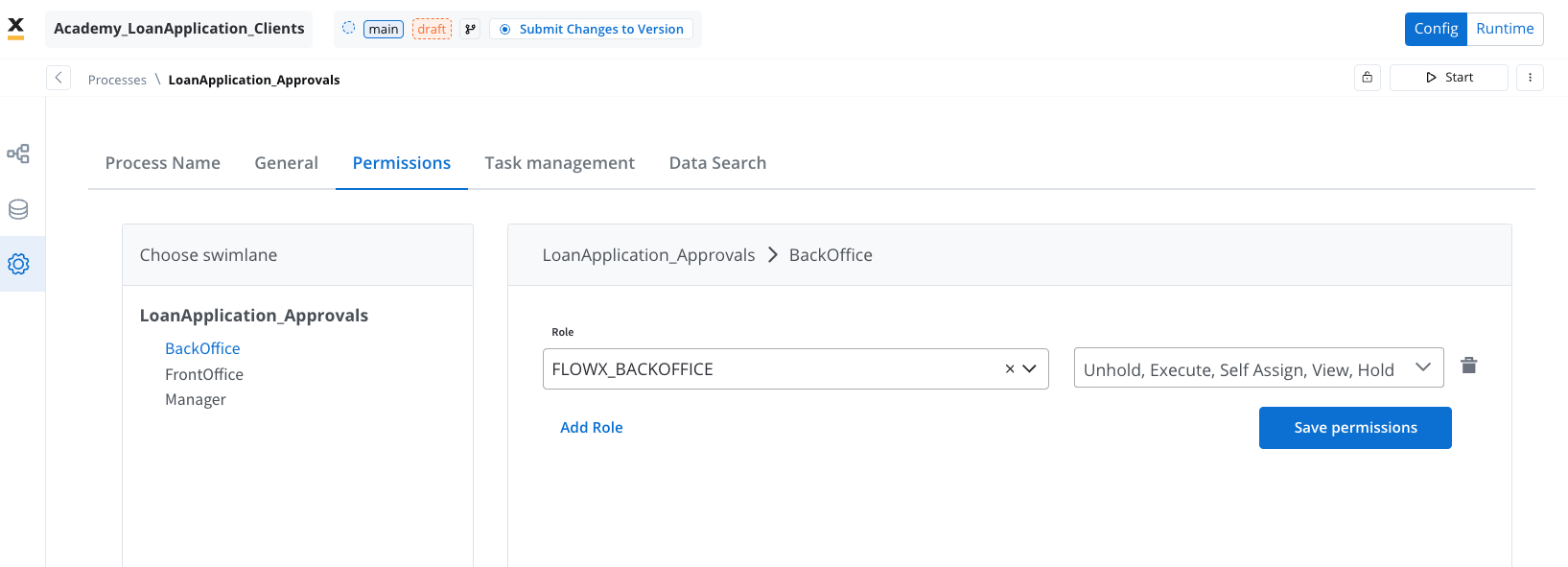
-
BackOffice Swimlane:
- Role:
FLOWX_BACKOFFICE - Permissions:
- Unhold: Allows the user to resume tasks that have been put on hold.
- Execute: Enables the user to perform task actions.
- Self Assign: Permits users to assign tasks to themselves.
- View: Grants viewing rights for tasks.
- Hold: Allows tasks to be temporarily paused.
- Role:
-
Manager (Supervisor) Swimlane:
- Role:
FLOWX_MANAGER - Permissions:
- Unhold: Allows the user to resume tasks that have been put on hold.
- Execute: Enables the user to perform task actions.
- Self Assign: Permits users to assign tasks to themselves.
- View: Grants viewing rights for tasks.
- Hold: Allows tasks to be temporarily paused.
- Role:
These permissions can be customized depending on each use case and organizational needs. Ensure that permissions are aligned with the roles’ responsibilities within the workflow.
Task assignment and reassignment
Consider this scenario: you’re the HR manager overseeing the onboarding process for new employees. To simplify this operation, you’ve opted to use the task manager plugin. This process consists of two key phases: the Initiation Stage and the Account Setup Stage, each requiring a designated team member. The Initiation Stage has successfully concluded, marking the transition to the Account Setup Stage. At this juncture, it’s essential to reassign the task, originally assigned to John Doe, to Jane Doe, a valuable member of the backoffice team.Hold/unhold tasks
As a project manager overseeing various ongoing projects, you may need to temporarily pause one due to unforeseen circumstances. To manage this, you use the “On Hold” status.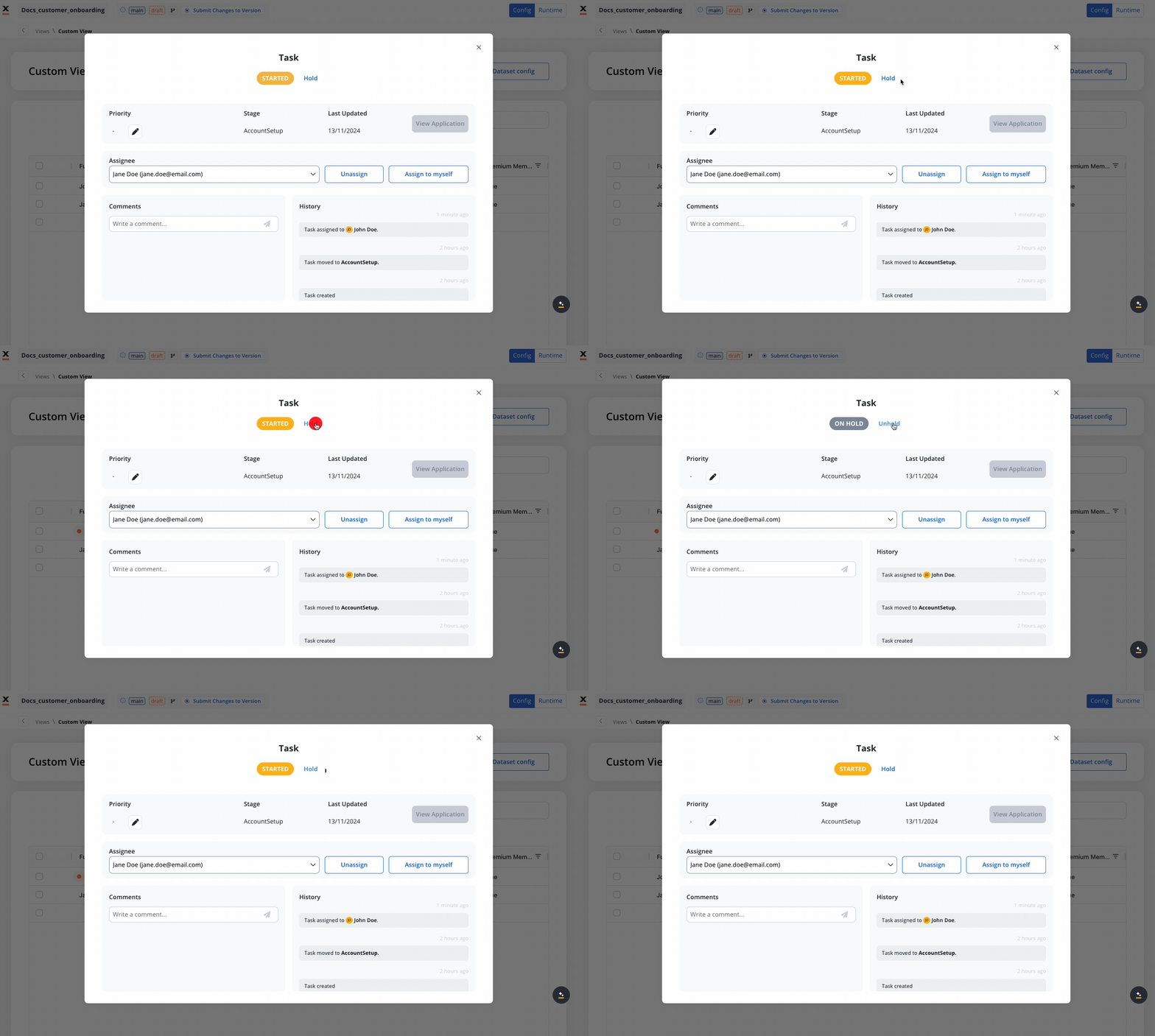
Adding comments
When handling on-hold projects, document the reasons, inform the team, and plan for resumption. This pause helps address issues and ensures a smoother project flow upon resuming. Never forget to add comments: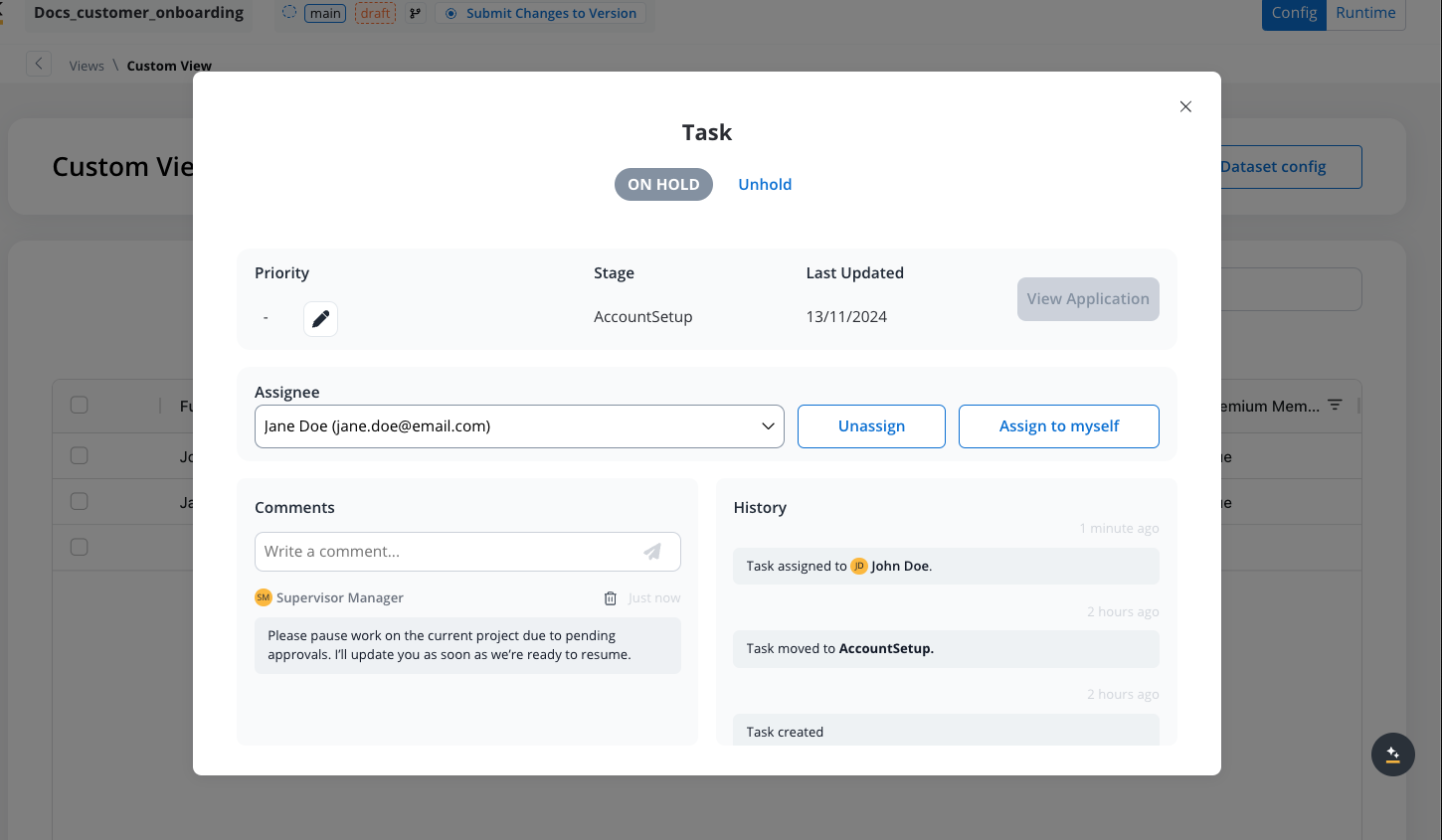
Viewing the application
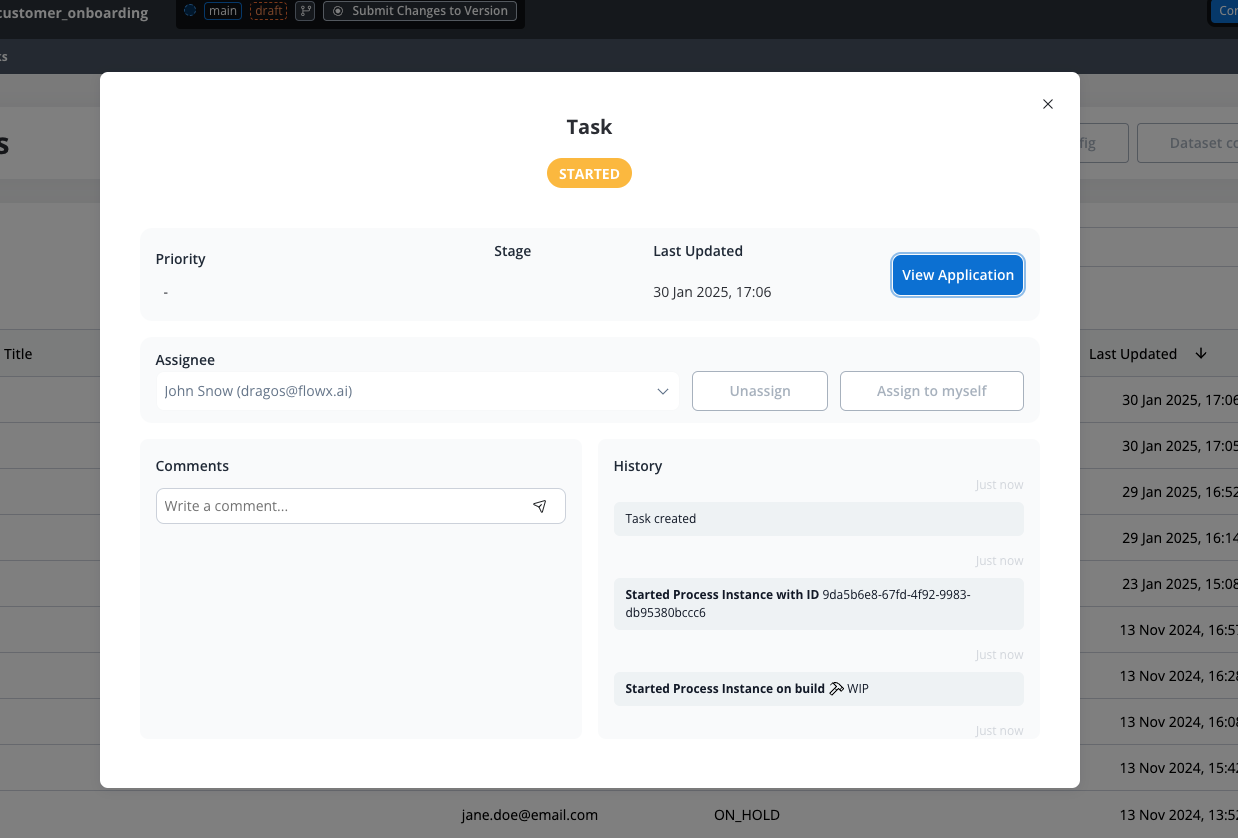
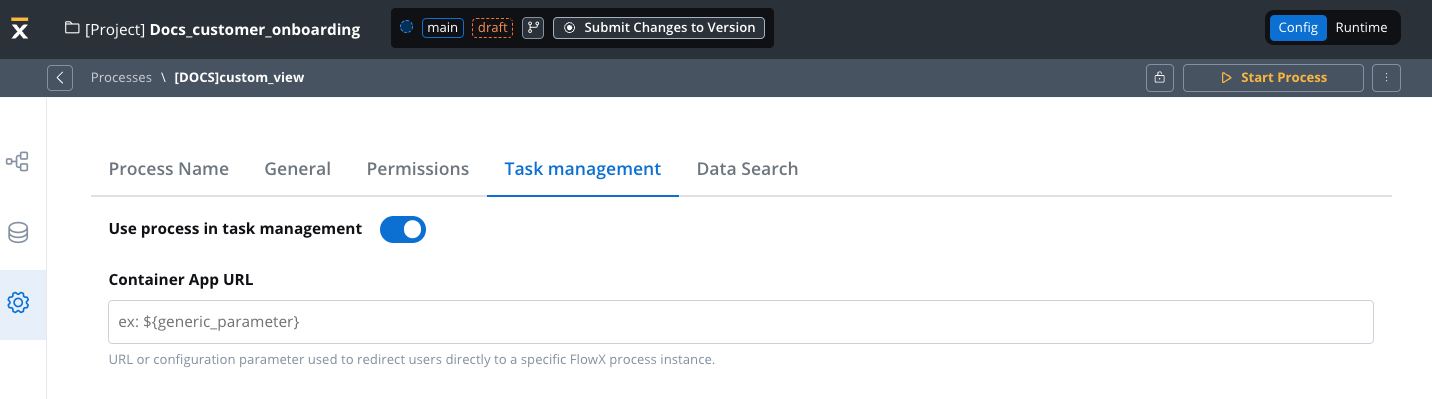
Process settings level
In the Process Definition settings, navigate to the Task Management tab and locate the Container App URL field. Here, paste the container application URL where the process is loaded, following this format: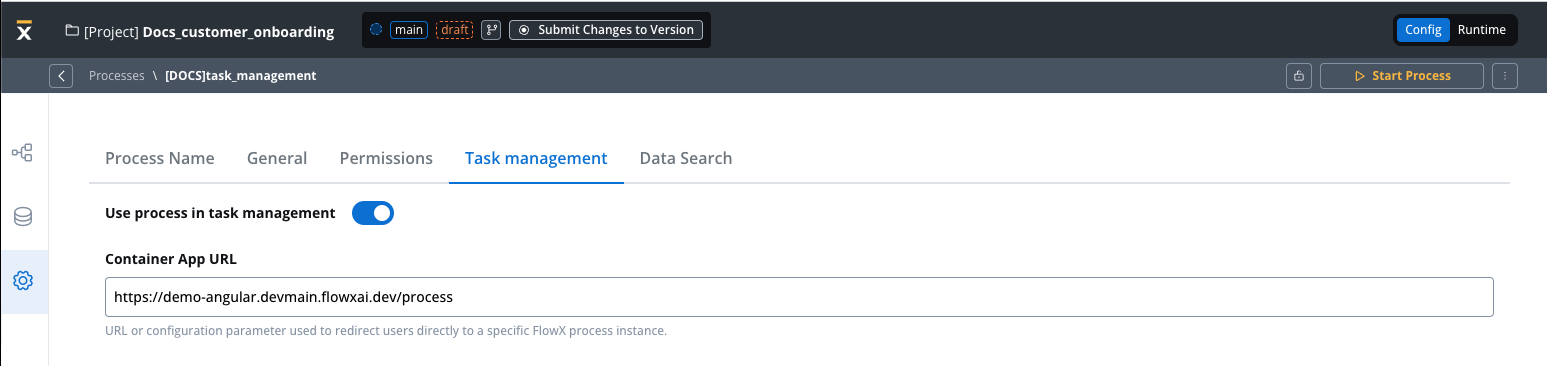
You can also use a predefined generic parameter as the URL: 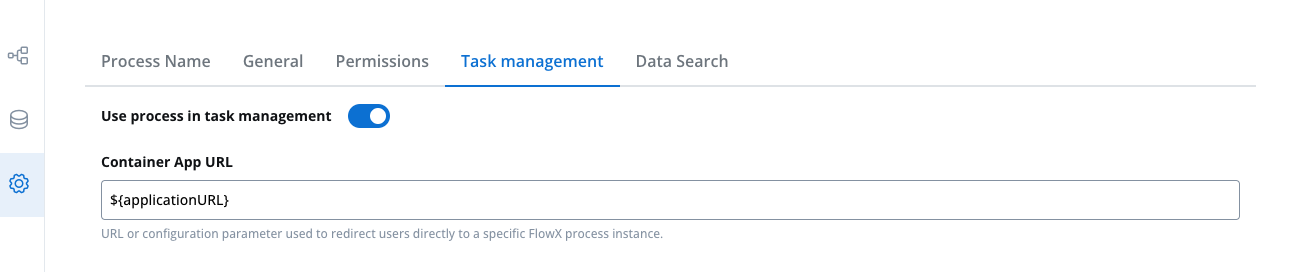
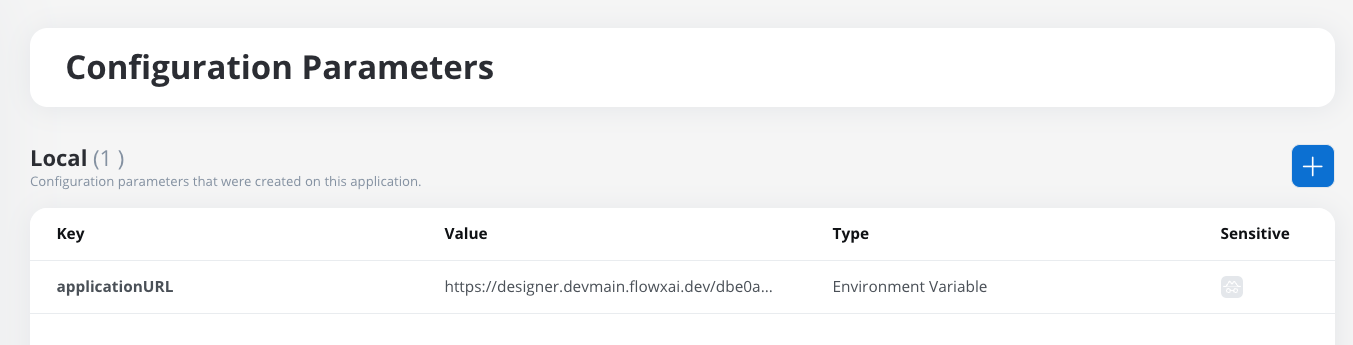
${genericParameter}.Process data level
If task.baseUrl is specified in the process parameters, it will be sent to the Task Manager to update the tasks accordingly.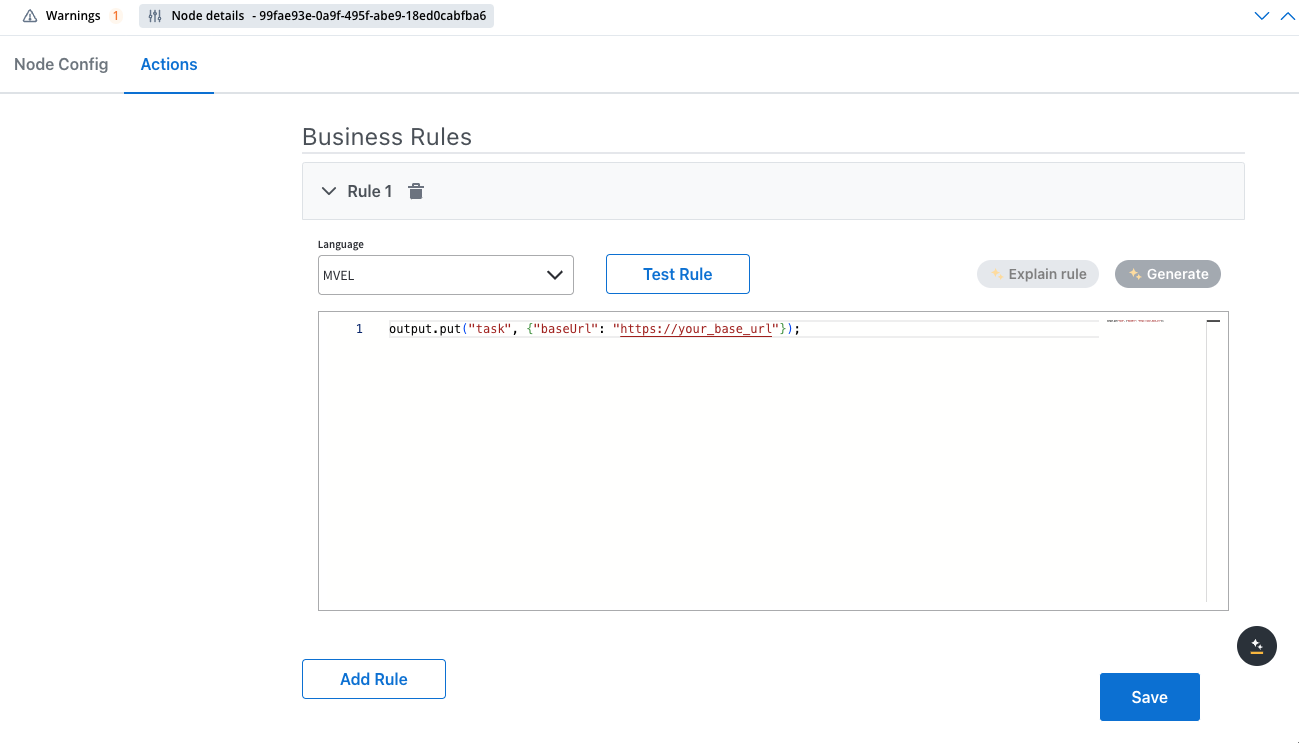
Task operations via Kafka
You can perform task operations programmatically by sending Kafka messages to theai.flowx.core.trigger.operation.v1 topic. This enables integration with external systems and automation of task management workflows.
Required Kafka headers
For details on how to obtain these values, see Finding Identifiers and Parameters.
Available operation types
Field descriptions
Owner object structure
Required parameters by operation
- ASSIGN
- UNASSIGN
- HOLD / UNHOLD
- TERMINATE
Minimal parameters required:
Example:
Bulk updates
Send bulk update requests via Kafka (using Process Engine) to perform multiple operations at once. Use the Kafka topic:- Send the operations as an array to the topic configured in the Process Engine’s
KAFKA_TOPIC_PROCESS_OPERATIONS_BULKINvariable (default:ai.flowx.core.trigger.operations.bulk.v1). The engine consumes the message and runs each operation in the array. For more information, see the Task Management plugin topics.
callbackTopic to receive a per-operation result list with SUCCESS, PARTIAL_ERROR, or ERROR status.
Example of a bulk request:
FlowX Engine setup
Updating Task Manager metadata through business rules
You can dynamically update task metadata during process execution using business rules. The engine intercepts values stored under the reservedtask key in the process data and forwards them to Task Management.
Reserved task.* keys
The following keys are reserved. When set via output.put("task", {...}) in a business rule, the engine extracts them and sends them to Task Management:
Updating task title and priority
Here is how to update both the title and priority:Setting dynamic value based on business logic
You can set priority dynamically based on business conditions: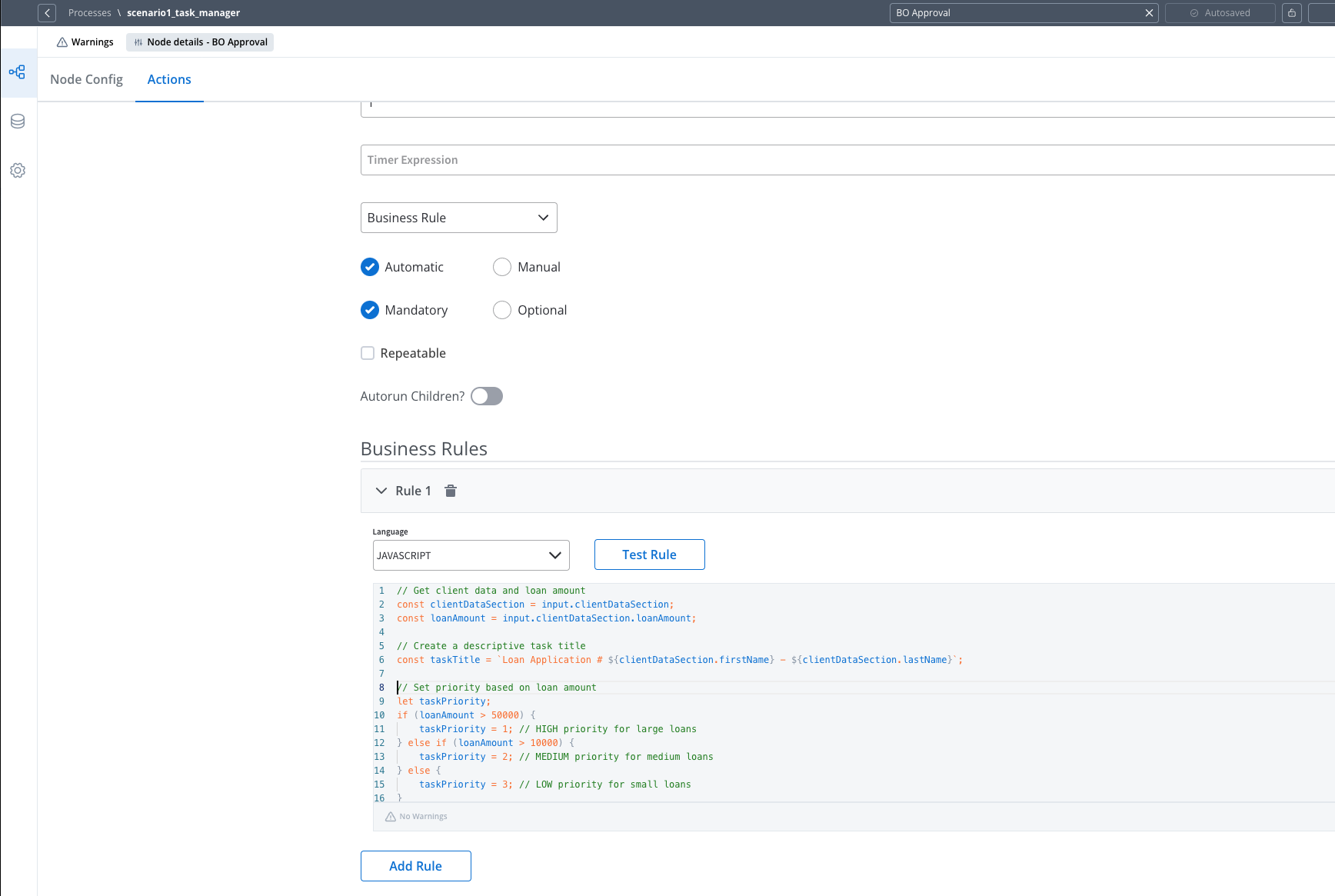
Full-Code implementation
For more customized UX, the full-code implementation using the Task Management SDKs (React and Angular) allows developers to build custom tables, cards, or any other UI elements based on the views and columns configured in Task Management.FAQs
What happens to currencies, numbers, and dates already indexed when a locale or format override is applied in the UI Designer?
What happens to currencies, numbers, and dates already indexed when a locale or format override is applied in the UI Designer?
A: The format changes will only affect how the data is displayed, not how it’s indexed.
Can I switch to full-code if I'm not satisfied with the current view and filter options?
Can I switch to full-code if I'm not satisfied with the current view and filter options?
A: Yes, you can always switch to full-code and create custom views or tables using the Task Management SDK.
How are subprocess keys handled in Task Management?
How are subprocess keys handled in Task Management?
A: To use data from a subprocess, you must send it to the parent process first. Subprocess keys are currently displayed in the task manager once indexed through the parent process.