

Infrastructure prerequisites
The FlowX Engine requires the following components to be set up before it can be started:- Docker Engine (version 17.06 or higher)
- Kafka (version 2.8 or higher)
- Elasticsearch (version 7.11.0 or higher)
- Database instance
Dependencies
The FlowX Engine has dependencies on the following components: For Microservices architecture, some Microservices holds their data individually using separate Databases. A basic Postgres configuration can be set up using a helm values.yaml file as it follows:-
helm values.yaml:
Redis server
A Redis cluster is required for caching process definitions, compiled scripts, and Kafka responses.Kafka cluster
Kafka serves as the backbone of the engine, facilitating communication with external plugins and integrations.Details about setting up logging via Elasticsearch, monitoring, and tracing via Open Telemetry can be found here.
Configuration
FlowX.AI Engine utilizes environment variables for configuration. Below are the key environment variables you need to configure:- Configuring authorization and access roles
- Configuring the data source
- Configuring Redis
- Configuring logging
- Configuring Kafka
- Configuring access roles for processes
Authorization & access roles
This section outlines the OAuth2 configuration settings for securing the Spring application, including resource server settings, security type, and access authorizations.Resource Server Settings (OAuth2 Configuration)
New configuration, starting from v4.1 release, available below.
Service account settings
This section contains the environment variables for configuring process engine service account.
More details about the necessary service account, here:
Process engine service account
Security configuration
Configuring Kafka
Kafka handles all communication between the FlowX.AI Engine and external plugins and integrations. It is also used for notifying running process instances when certain events occur.Kafka connection settings
Kafka consumer retry settings
Consumer groups & consumer threads configuration
Both a producer and a consumer must be configured:Configuring a Kafka Producer
Configuring a Kafka Consumer
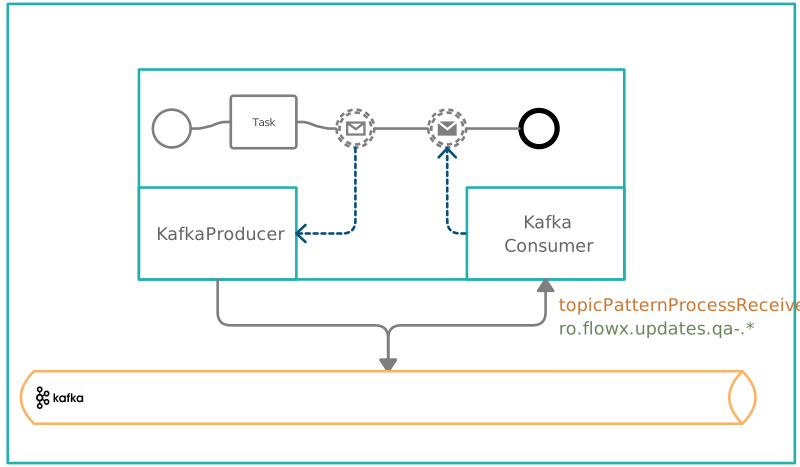
Consumer groups & consumer threads
In Kafka a consumer group is a group of consumers that jointly consume and process messages from one or more Kafka topics. Each consumer group has a unique identifier called a group ID, which is used by Kafka to manage message consumption and distribution among the members of the group. Thread numbers, on the other hand, refer to the number of threads that a consumer application uses to process messages from Kafka. By default, each consumer instance runs in a single thread, which can limit the throughput of message processing. Increasing the number of consumer threads can help to improve the parallelism and efficiency of message consumption, especially when dealing with high message volumes. Both group IDs and thread numbers can be configured in Kafka to optimize the processing of messages according to specific requirements, such as message volume, message type, and processing latency. The configuration related to consumers (group ids and thread numbers) can be configured separately for each message type as it follows:Consumer Group Configuration
Consumer Thread Configuration
It is important to know that all the events that start with a configured pattern will be consumed by the engine. This makes it possible to create a new integration and connect it to the engine without changing the configuration of the engine.
Configuring kafka topics
Topics related to the Task Management plugin
OPERATIONS_IN request example
BULK_IN request example
If you need to send additional keys on the response, attach them in the header, as in the following example, where we used
requestID key.A response should be sent on a 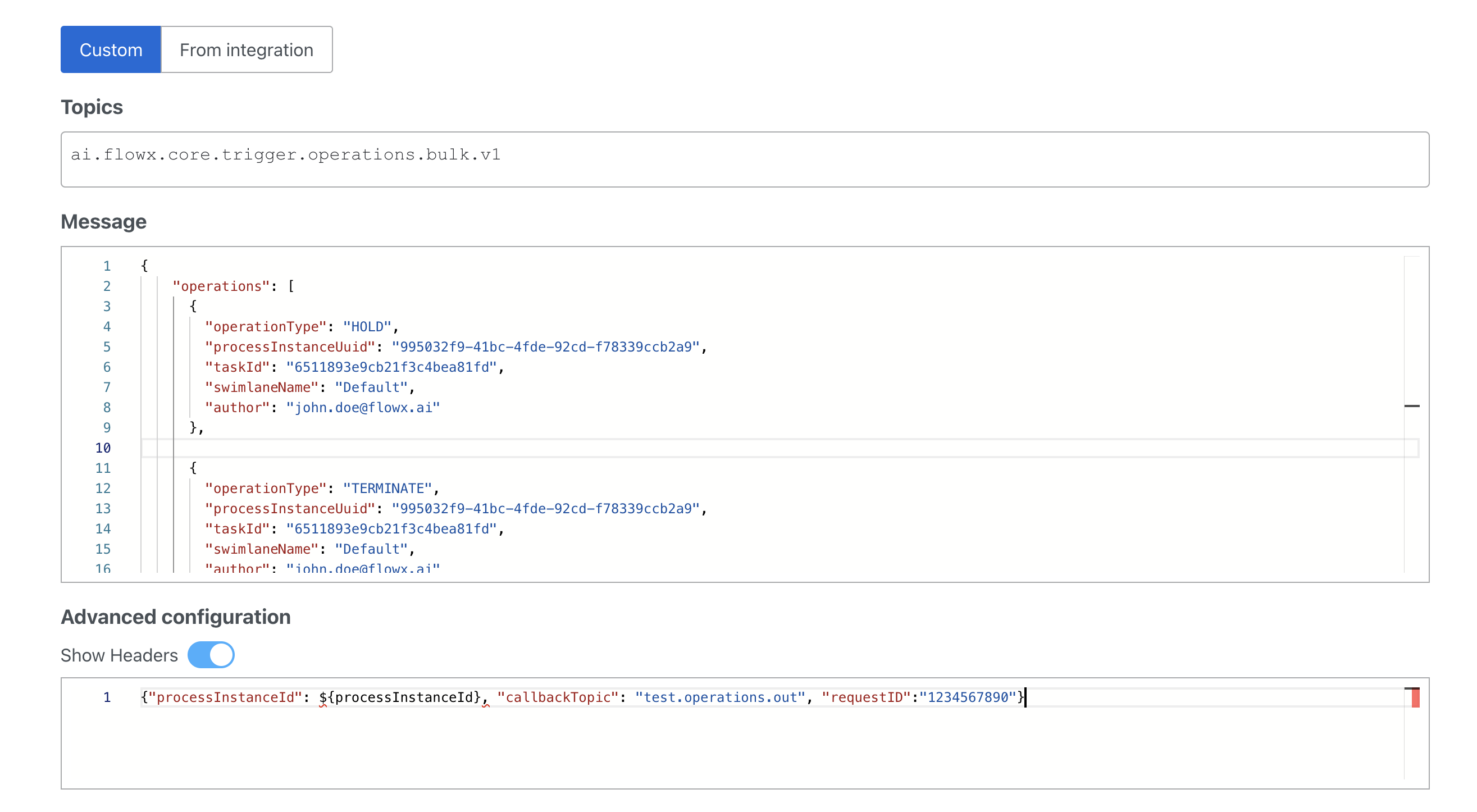
callbackTopic if it is mentioned in the headers, as in the following example:Task manager operations could be the following: assignment, unassignment, hold, unhold, terminate and it is matched with the
...operations.out topic on the engine side. For more information check the Task Management plugin documentation:📄 Task management pluginTopics related to the scheduler extension
SchedulerUsing the scheduler
Topics related to Timer Events
Topics related to the Search Data service
Topics related to the Audit service
Topics related to ES indexing
Processes that can be started by sending messages to a Kafka topic
Topics related to Message Events
Topics related to events-gateway microservice
Configuring file upload size
The maximum file size allowed for uploads can be set by using the following environment variables:Configuring Advancing controller
To use advancing controller, the following env vars are needed forprocess-engine to connect to Advancing Postgres DB:
Advancing controller setup
Configuring cleanup mechanism
This section contains environment variables that configure the scheduler’s behavior, including thread count, cron jobs for data partitioning, process cleanup, and master election.Managing Subprocesses Expiration
This section details the environment variable that controls the expiration of subprocesses within a parent process. It determines whether subprocesses should terminate when the parent process expires or follow their own expiration settings.Partitioning and archiving
The Partitioning and Archiving feature is optional and can be configured as needed.