> ## Documentation Index
> Fetch the complete documentation index at: https://docs.flowx.ai/llms.txt
> Use this file to discover all available pages before exploring further.
# Deployment guidelines v5.9.0
> Component versions, environment variables, and configuration changes for FlowX.AI 5.9.0 deployments.
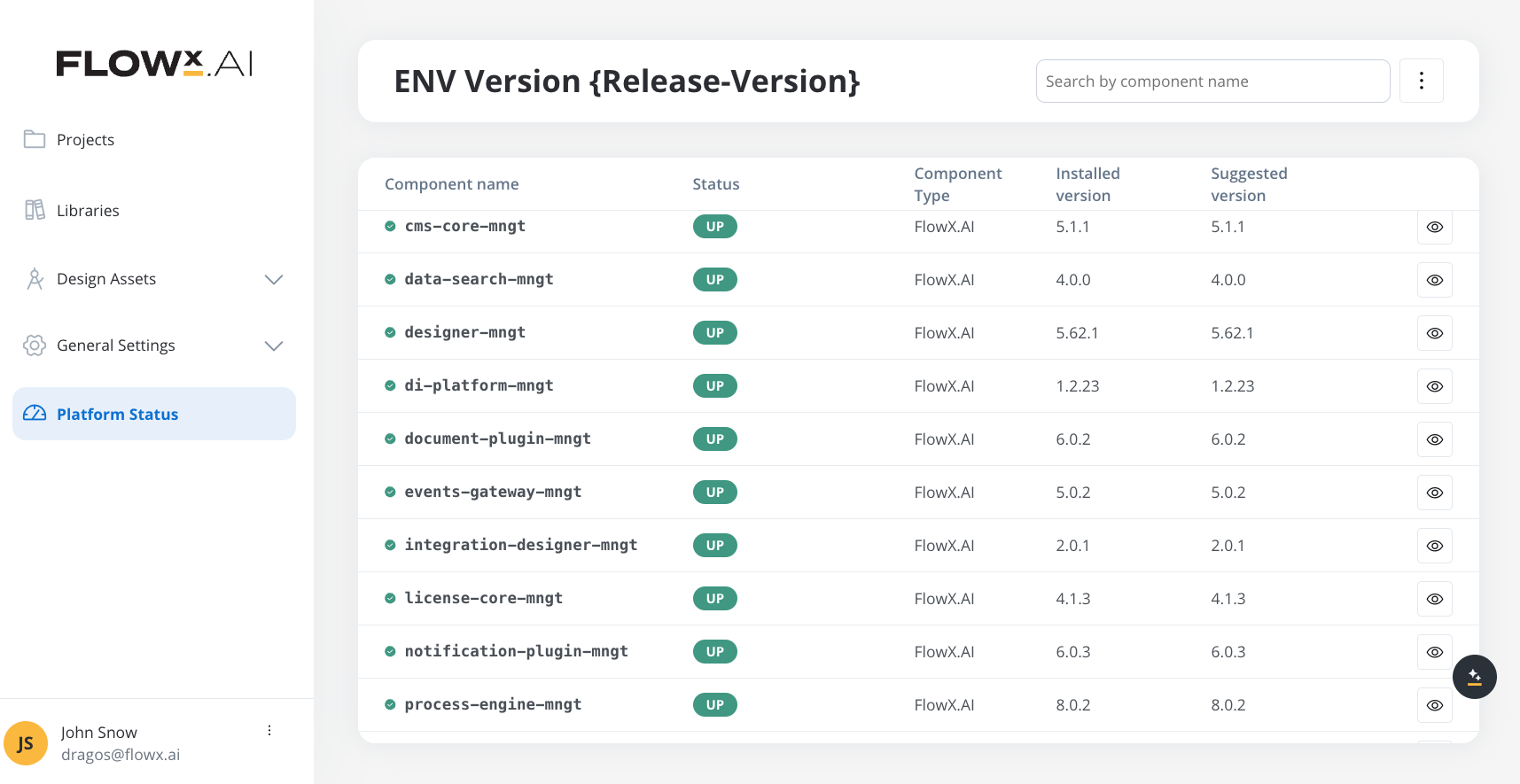
After upgrading to a new platform version, always ensure that your installed component versions match the versions specified in the release notes. To verify this, navigate to **FlowX.AI Designer > Platform Status**.
**Upgrading from 5.1.x LTS?** This page describes the steady-state 5.9.0 deployment. For the architecture delta, deprecation list, and upgrade steps, see [Migrating from 5.1 LTS](/5.9/migrating-from-5.1-lts/overview).
## Component versions
The following tables list component versions per FlowX.AI release. Verify your installed versions against the 5.9.0 column in **FlowX.AI Designer → Platform Status**.
| Component | 5.9.0 | 5.8.0 | 5.7.0 | 5.6.0 | 5.5.0 | 5.4.0 |
| -------------------------- | -------- | -------- | -------- | -------- | ------- | ------- |
| **process-engine** | 10.135.0 | 10.106.0 | 10.96.0 | 10.77.0 | 10.60.0 | 10.38.0 |
| **admin** | 10.116.0 | 10.93.0 | 10.83.0 | 10.66.0 | 10.53.0 | 10.38.0 |
| **designer** | 10.230.2 | 10.181.0 | 10.164.0 | 10.127.3 | 10.91.0 | 10.59.1 |
| **cms-core** | 10.86.0 | 10.67.0 | 10.58.0 | 10.43.0 | 10.35.0 | 10.22.0 |
| **scheduler-core** | 10.70.0 | 10.53.0 | 10.45.0 | 10.31.0 | 10.25.0 | 10.15.0 |
| **events-gateway** | 10.72.0 | 10.55.0 | 10.47.0 | 10.33.1 | 10.27.0 | 10.17.0 |
| **notification-plugin** | 10.83.0 | 10.64.0 | 10.56.0 | 10.42.1 | 10.35.0 | 10.22.0 |
| **document-plugin** | 10.94.0 | 10.75.0 | 10.64.0 | 10.46.0 | 10.35.0 | 10.23.0 |
| **task-management-plugin** | 10.84.0 | 10.66.0 | 10.57.0 | 10.41.1 | 10.35.0 | 10.25.0 |
| **data-search** | 10.69.0 | 10.52.0 | 10.44.0 | 10.30.1 | 10.25.0 | 10.14.0 |
| **audit-core** | 10.79.0 | 10.63.0 | 10.54.0 | 10.40.0 | 10.31.0 | 10.21.0 |
| **advancing-controller** | 10.73.0 | 10.55.0 | 10.45.0 | 10.33.1 | 10.27.0 | 10.16.0 |
| **integration-designer** | 10.162.0 | 10.128.0 | 10.113.0 | 10.84.0 | 10.63.0 | 10.38.0 |
| **application-manager** | 10.123.0 | 10.97.0 | 10.88.0 | 10.69.1 | 10.53.0 | 10.37.0 |
| **runtime-manager** | 10.123.0 | 10.97.0 | 10.88.0 | 10.69.1 | 10.53.0 | 10.37.0 |
| **data-sync** | 10.81.0 | 10.58.0 | 10.50.0 | 10.38.0 | 10.31.1 | 10.20.1 |
| **authorization-system** | 10.96.1 | 10.77.0 | 10.68.0 | 10.51.0 | 10.42.1 | 10.28.0 |
| **nosql-db-runner** | 10.75.0 | 10.56.0 | 10.48.0 | 10.34.0 | 10.27.0 | 10.17.0 |
| **email-gateway** | 10.74.0 | 10.56.0 | 10.47.0 | 10.32.1 | 10.24.0 | 10.9.0 |
| **organization-manager** | 10.71.0 | 10.53.0 | 10.44.0 | 10.26.1 | 10.19.2 | - |
| **webhook-gateway** | 10.44.0 | 10.25.0 | 10.15.0 | 10.1.1 | - | - |
| **file-gateway** | 10.8.0 | - | - | - | - | - |
| **license** | 10.63.0 | 10.46.0 | 10.36.0 | - | - | - |
### Embedded components
* **SpiceDB**
### Renderers
| Component | 5.9.0 | 5.8.0 | 5.7.0 | 5.6.0 | 5.5.0 | 5.4.0 |
| ---------------------------------- | -------- | -------- | -------- | -------- | ------- | ------- |
| **@flowx/angular-sdk** | 10.230.2 | 10.181.0 | 10.164.0 | 10.127.3 | 10.68.0 | 10.59.1 |
| **@flowx/angular-theme** | 10.230.2 | 10.181.0 | 10.164.0 | 10.127.3 | 10.68.0 | 10.59.1 |
| **@flowx/angular-ui-toolkit** | 10.230.2 | 10.181.0 | 10.164.0 | 10.127.3 | 10.68.0 | 10.59.1 |
| **@flowx/react-sdk** | 10.230.2 | 10.181.0 | 10.164.0 | 10.127.3 | 10.68.0 | 10.59.1 |
| **@flowx/react-theme** | 10.230.2 | 10.181.0 | 10.164.0 | 10.127.3 | 10.68.0 | 10.59.1 |
| **@flowx/react-ui-toolkit** | 10.230.2 | 10.181.0 | 10.164.0 | 10.127.3 | 10.68.0 | 10.59.1 |
| **@flowx/react-native-sdk** | 10.230.2 | - | - | - | - | - |
| **@flowx/react-native-theme** | 10.230.2 | - | - | - | - | - |
| **@flowx/react-native-ui-toolkit** | 10.230.2 | - | - | - | - | - |
| **@flowx/core-sdk** | 10.230.2 | 10.181.0 | 10.164.0 | 10.127.3 | 10.68.0 | 10.59.1 |
| **@flowx/core-theme** | 10.230.2 | 10.181.0 | 10.164.0 | 10.127.3 | 10.68.0 | 10.59.1 |
| **react-saas** | 10.230.2 | - | - | - | - | - |
| **iOS renderer** | 10.4.1 | 10.3.0 | 10.3.0 | 10.3.0 | 10.3.0 | 10.2.0 |
| **Android renderer** | 10.5.0 | 10.3.0 | 10.3.0 | 10.3.0 | 10.3.0 | 10.2.0 |
The **react-saas** container app tracks the designer version.
### Plugins
| Component | 5.9.0 | 5.8.0 | 5.7.0 | 5.6.0 | 5.5.0 | 5.4.0 |
| -------------------- | ------ | ------ | ------ | ------ | ------ | ------ |
| **ocr-plugin** | 1.0.19 | 1.0.17 | 1.0.17 | 1.0.17 | 1.0.17 | 1.0.17 |
| **reporting-plugin** | 0.2.6 | 0.2.3 | 0.2.3 | 0.2.3 | 0.2.3 | 0.2.3 |
### AI components
FlowX.AI groups AI services into four tiers by deployment role. **AI Base** components are the foundation; **AI Runtime** and **AI Dev Time** components both require Base to be installed first; **AI Extensions** are optional add-ons layered on top.
#### AI Base components
Foundation services. Install these before any Runtime or Dev Time component.
| Component | 5.9.0 | 5.8.0 | 5.7.0 | 5.6.0 | 5.5.0 | 5.4.0 |
| ---------------------------------------- | ------ | ------ | ------ | ------ | ------ | ----- |
| **ai-platform-knowledgebase-indexer-v2** | 10.7.0 | 10.7.0 | 10.6.2 | 10.6.0 | 10.2.0 | - |
| **ai-platform-knowledgebase-rag** | 10.7.0 | 10.7.0 | 10.6.2 | 10.6.0 | 10.2.0 | - |
| **ai-platform-embedder** | 10.7.0 | 10.7.0 | 10.6.2 | - | - | - |
| **doc-parser** | 10.9.0 | 10.7.0 | 10.6.2 | 10.5.1 | - | - |
| **qdrant** | - | - | - | - | - | - |
#### AI Runtime components
Requires AI Base. Services that execute AI workloads at runtime.
| Component | 5.9.0 | 5.8.0 | 5.7.0 | 5.6.0 | 5.5.0 | 5.4.0 |
| ----------------------------- | ------ | ------ | ------ | ------ | ------ | ------ |
| **ai-platform-agent-builder** | 10.7.0 | 10.7.0 | 10.6.2 | 10.6.0 | 10.4.0 | 10.1.3 |
| **data-privacy** | 10.1.0 | 10.1.0 | 10.0.8 | - | - | - |
| **doc-converter** | 10.2.3 | 10.2.3 | 10.2.3 | 10.2.2 | - | - |
| **evals-judge** | 10.1.1 | - | - | - | - | - |
| **speech-to-text** | 10.3.4 | - | - | - | - | - |
| **web-crawler** | 10.3.5 | 10.3.5 | 10.3.2 | - | - | - |
#### AI Dev Time components
Requires AI Base. Services used at design time inside the Designer.
| Component | 5.9.0 | 5.8.0 | 5.7.0 | 5.6.0 | 5.5.0 | 5.4.0 |
| ---------------------------- | ------ | ------ | ------ | ------ | ------ | ------ |
| **ai-gateway** | 10.7.0 | - | - | - | - | - |
| **ai-platform-ai-analyst** | 10.7.0 | 10.7.0 | 10.6.2 | 10.6.0 | 10.4.0 | 10.1.3 |
| **ai-platform-ai-assistant** | 10.7.0 | 10.7.0 | 10.6.2 | - | - | - |
| **ai-platform-ai-designer** | 10.7.0 | 10.7.0 | 10.6.2 | 10.6.0 | 10.4.0 | 10.1.3 |
| **ai-platform-ai-developer** | 10.7.0 | 10.7.0 | 10.6.2 | 10.6.0 | 10.4.0 | 10.1.3 |
| **ai-platform-planner** | 10.7.0 | 10.7.0 | 10.6.2 | 10.6.0 | 10.4.0 | 10.1.3 |
| **di-platform** | 10.3.1 | 10.3.0 | 10.3.0 | 10.3.0 | 10.2.6 | 10.2.5 |
| **flowx-docs** | 5.9.0 | - | - | - | - | - |
#### AI Extensions (Plugins++)
Optional add-ons layered on the AI Platform.
| Component | 5.9.0 | 5.8.0 | 5.7.0 | 5.6.0 | 5.5.0 | 5.4.0 |
| ------------------ | ------ | ------ | ------ | ----- | ----- | ----- |
| **modpod** | 10.0.7 | 10.0.7 | 10.0.7 | - | - | - |
| **ai-observatory** | 10.3.2 | - | - | - | - | - |
***
## Third-party recommended component versions
| FlowX.AI Version | 3rd Party Dependency | Supported Versions | Dropped |
| ---------------- | --------------------------------- | ------------------ | ----------------------- |
| 5.9.0 | Keycloak | 26+ | |
| 5.9.0 | Kafka | 3.9 - 4.2 | 3.8 |
| 5.9.0 | PostgreSQL | 16 - 18 | |
| 5.9.0 | Oracle Database | 21c, 23ai | |
| 5.9.0 | MongoDB | 7 - 8 | |
| 5.9.0 | Redis | 8.2+ | Versions older than 8.2 |
| 5.9.0 | Elasticsearch Sink Connector (\*) | 15+ | |
| 5.9.0 | Angular (Web SDK) | 20 | |
| 5.9.0 | React (Web SDK) | 19 | 18.x |
Note that versions will be dropped from the supported list as support upstream is no longer provided.
(\*) Required only if using indexing via Kafka. Multiple sink connector implementations also work, as long as they are compatible with both the deployed Kafka and Elasticsearch version deployed.
**LTS support policy.** FlowX 5.9.x LTS family is supported for 2 years. Within that window, support for any third-party dependency is contingent on that dependency remaining supported by its upstream vendor. Once a version reaches upstream end-of-life, it is removed from the supported list and customers are expected to upgrade to a still-supported version, even if the FlowX LTS itself remains supported.
***
## Kafka topics
### Document-plugin archive and extract listeners
5.9.0 exposes four Kafka topics for the document-plugin **archive** and **extract** operations. Both follow the encrypt/decrypt trigger and reply pattern: document-plugin consumes the `trigger.*.file` topic and process-engine consumes the matching `engine.receive.*.file.results` reply.
| Topic | Producer | Consumer |
| ----------------------------------------------------------------- | --------------- | --------------- |
| `ai.flowx.plugin.document.trigger.archive.file.v1` | process-engine | document-plugin |
| `ai.flowx.engine.receive.plugin.document.archive.file.results.v1` | document-plugin | process-engine |
| `ai.flowx.plugin.document.trigger.extract.file.v1` | process-engine | document-plugin |
| `ai.flowx.engine.receive.plugin.document.extract.file.results.v1` | document-plugin | process-engine |
The four topic names are exposed as env vars on the document-plugin side (`KAFKA_TOPIC_FILE_ARCHIVE_IN`, `KAFKA_TOPIC_FILE_ARCHIVE_OUT`, `KAFKA_TOPIC_FILE_EXTRACT_IN`, `KAFKA_TOPIC_FILE_EXTRACT_OUT`). See [Documents plugin setup → File archive / File extract](/5.9/setup-guides/documents-plugin-setup#file-archive). Two new thread-pool entries are added: `KAFKA_CONSUMER_THREAD_POOLS_THREADPOOLGENERIC_THREAD_COUNT_PER_CONTAINER_FILEARCHIVEIN` and `..._FILEEXTRACTIN`, both defaulting to `5`.
### Document-plugin encrypt and decrypt listeners
The **encrypt** and **decrypt** operations follow the same trigger-and-reply pattern: process-engine produces the `trigger.*.file` topic and document-plugin replies on the matching `engine.receive.*.file.results` topic.
| Topic | Producer | Consumer |
| ----------------------------------------------------------------- | --------------- | --------------- |
| `ai.flowx.plugin.document.trigger.encrypt.file.v1` | process-engine | document-plugin |
| `ai.flowx.engine.receive.plugin.document.encrypt.file.results.v1` | document-plugin | process-engine |
| `ai.flowx.plugin.document.trigger.decrypt.file.v1` | process-engine | document-plugin |
| `ai.flowx.engine.receive.plugin.document.decrypt.file.results.v1` | document-plugin | process-engine |
The topic names are exposed as env vars on the document-plugin side: `KAFKA_TOPIC_FILE_ENCRYPT_IN`, `KAFKA_TOPIC_FILE_ENCRYPT_OUT`, `KAFKA_TOPIC_FILE_DECRYPT_IN`, `KAFKA_TOPIC_FILE_DECRYPT_OUT`.
### AI Platform job topics
`integration-designer` dispatches asynchronous jobs to the standalone AI services over Kafka, using a request/response pair per service. Provision these topics when you deploy the corresponding AI service (see [AI components](#ai-components) above).
| Topic | Producer | Consumer |
| ----------------------------------------------------- | -------------------- | -------------------- |
| `ai.flowx.ai-platform.doc-parser.job.request.v1` | integration-designer | doc-parser |
| `ai.flowx.ai-platform.doc-parser.job.response.v1` | doc-parser | integration-designer |
| `ai.flowx.ai-platform.evals-judge.job.request.v1` | integration-designer | evals-judge |
| `ai.flowx.ai-platform.evals-judge.job.response.v1` | evals-judge | integration-designer |
| `ai.flowx.ai-platform.speech-to-text.job.request.v1` | integration-designer | speech-to-text |
| `ai.flowx.ai-platform.speech-to-text.job.response.v1` | speech-to-text | integration-designer |
On `integration-designer` the topic names are set via `KAFKA_TOPIC_AI__JOB_REQUEST_OUT` and `..._RESPONSE_IN` (for example `KAFKA_TOPIC_AI_EVALSJUDGE_JOB_REQUEST_OUT`). Each service also has a dead-letter topic — `ai.flowx.ai-platform..job.dlq.v1`, set via `KAFKA_TOPIC_AI__JOB_DLQ_IN` — that integration-designer consumes for failed jobs.
### UI Flow runtime triggers
process-engine consumes two trigger topics that back the UI Flow runtime cache and expiration features. `update` invalidates a cached UI Flow when its definition changes; `expire` removes expired UI Flow runtime data.
| Topic | Producer | Consumer |
| ----------------------------------------- | ------------------------------------- | -------------- |
| `ai.flowx.core.trigger.ui-flow.update.v1` | document-plugin, integration-designer | process-engine |
| `ai.flowx.core.trigger.expire.ui-flow.v1` | scheduler-core | process-engine |
On process-engine these are set via `KAFKA_TOPIC_UIFLOW_UPDATE_IN` and `KAFKA_TOPIC_UIFLOW_EXPIRE_IN`; the producers expose `KAFKA_TOPIC_UIFLOW_UPDATE_OUT`. The expire trigger uses the platform scheduler: when a UI Flow session is created, process-engine registers a delayed message with scheduler-core, which publishes it back to this topic at the expiry time. It is consumed by a dedicated consumer group (`KAFKA_CONSUMER_GROUPID_PROCESS_UIFLOWEXPIRE`, default `ui-flow-expire`).
***
## Environment variables
**A configuration that blocks startup is a required configuration.** If a service fails to start and its logs report a missing or empty configuration value, treat that value as required and provide it, even when it is not flagged as required here. These guides document the most common variables; they are not an exhaustive list of every value your deployment topology requires.
### Data-sync: Keycloak admin credentials
The data-sync job provisions FlowX-managed end-user groups and runtime roles in Keycloak on first run, using the Keycloak admin API. Configure the following on the data-sync job:
| Environment Variable | Description | Default Value | Component |
| ------------------------- | ----------------------------------------------------------------------------------------------------------------------------------------------------------- | ------------- | --------- |
| `FLOWX_OPENID_PROVIDER` | OpenID provider type. Set to `keycloak` (the only supported provider). | `-` | data-sync |
| `FLOWX_OPENID_SERVER_URL` | Base URL of the Keycloak server, including the `/auth/` path. | `-` | data-sync |
| `FLOWX_OPENID_USER` | Username of a Keycloak admin account that can manage groups and roles in the FlowX realm. | `-` | data-sync |
| `FLOWX_OPENID_PASSWORD` | Password for the admin account above. Store in a Kubernetes Secret. | `-` | data-sync |
| `FLOWX_OPENID_CLIENT_ID` | Keycloak admin client used to obtain the admin token. Typically `admin-cli` for standard Keycloak deployments. Must be set explicitly. There is no default. | `-` | data-sync |
For full data-sync configuration, see [Data-sync job setup](/5.9/setup-guides/data-sync#openid-provider-configuration).
### Anonymous service account: shared client secret
5.9.x introduces a single shared service-account client, `flowx-anonymous-sa`, used by FlowX backend services for inter-service calls on anonymous (unauthenticated) runtime flows. One client secret is reused across all consumers — it must be provided in two places.
**On `authorization-system`** — passed to Liquibase so the client is provisioned with the correct secret when FlowX manages Keycloak:
| Environment Variable | Description | Default Value | Component |
| ------------------------------------------------------------------------- | -------------------------------------------------------------------------------------------------------------------------------------------------------------------------- | ------------- | ---------------------- |
| `SPRING_LIQUIBASE_PARAMETERS_SECRETS_SERVICE_ACCOUNTS_FLOWX_ANONYMOUS_SA` | Client secret used by Liquibase to create the `flowx-anonymous-sa` client in the service-accounts realm at first boot. Required when `SECURITY_KEYCLOAKADMINENABLED=true`. | `-` | `authorization-system` |
**On every consuming service** — the Spring Security OAuth2 client registration for the `anonymousidentity` alias resolves the same secret at runtime:
| Environment Variable | Description | Default Value | Component |
| ---------------------------------------------------------------------------- | ------------------------------------------------------------------------------------------------------------------------------------------------ | ------------- | ------------------------------------------------------------------------------------------------------------------------------------------------------------------------------------------------------------------------------------------------------------------------------------------------------------------------ |
| `SPRING_SECURITY_OAUTH2_CLIENT_REGISTRATION_ANONYMOUSIDENTITY_CLIENT_SECRET` | Client secret for the `anonymousidentity` registration. **Must be the same value across every service** — it is a single shared service account. | `-` | `admin`, `application-manager`, `authorization-system`, `document-plugin`, `email-gateway`, `events-gateway`, `file-gateway`, `integration-designer`, `license`, `mock-server`, `nosql-db-runner`, `organization-manager`, `process-engine`, `runtime-manager`, `scheduler`, `task-management-plugin`, `webhook-gateway` |
This is a secret. Store it in your secrets management solution (e.g., Kubernetes Secret, Vault) and reference it from there. Never commit it to version control.
For the Keycloak-side context (`flowx-anonymous-sa` client, `SA_FLOWX_ANONYMOUS` realm role, manual-configuration recipe for deployments without Keycloak admin access), see [Manual Keycloak configuration](/5.9/setup-guides/access-management/configuring-an-iam-solution#manual-keycloak-configuration).
### Knowledgebase-rag: Qdrant search tuning
Two env vars control the fanout of dense and sparse Qdrant queries inside the `knowledgebase-rag` service. Defaults are tunable per environment.
| Environment Variable | Description | Default Value | Component |
| ----------------------- | ---------------------------------------------------------------------------------------------------------------------------- | ------------- | ----------------- |
| `QDRANT_PREFETCH_LIMIT` | Maximum points returned by each dense/sparse prefetch stage in a hybrid search before fusion. | `100` | knowledgebase-rag |
| `QDRANT_FUSION_LIMIT` | Maximum points returned after RRF fusion (hybrid search) or by a single-stage dense/keyword search. Caps the reranker input. | `80` | knowledgebase-rag |
Raise both when recall is insufficient on very large or long-tailed Knowledge Bases. Lower them when Qdrant pods report memory pressure or filter-heavy queries time out.
### CORS handling: `APPLICATION_CORS_ALLOW_ORIGIN`
CORS is enforced at the application layer. Each backend service exposed via admin or public URLs reads its allowed-origin list from a single environment variable. Allowed methods, allowed headers, exposed headers, and credential handling are baked into each service's `application.yaml` with safe defaults. The 5.9.x default allow-headers set is `Accept, Content-Type, Authorization, Fx-Workspace-Id, Fx-Client-Host, Referer, User-Agent, Flowx-Platform, X-Fx-Anonymous-Session-Id, Fx-BuildId, Fx-AppId`, and `X-Fx-Anonymous-Session-Id` is exposed to the browser for anonymous runtime sessions. Only `APPLICATION_CORS_ALLOW_ORIGIN` is deployment-specific.
| Environment Variable | Description | Default Value | Component |
| --------------------------------- | --------------------------------------------------------------------------------------------------------------------------------------------------------------------------------------------------------------------------------------- | --------------------------- | ----------------------------------------------------------------------------------------------------------------------------------------------------------------------------------------------------------------------------------------------------------------------------------------------------------------------- |
| `APPLICATION_CORS_ALLOW_ORIGIN` | Comma-separated list of origins allowed to call this service from the browser. Supports wildcard subdomains (`https://*.yourcompany.com`). Must include every Designer, runtime renderer, and integration domain that calls FlowX APIs. | `-` | `admin`, `ai-gateway`, `application-manager`, `audit-core`, `authorization-system`, `cms-core`, `document-plugin`, `events-gateway`, `file-gateway`, `integration-designer`, `license`, `notification-plugin`, `organization-manager`, `process-engine`, `runtime-manager`, `task-management-plugin`, `webhook-gateway` |
| `APPLICATION_CORS_EXPOSEDHEADERS` | Response headers exposed to browser JavaScript. The default carries the anonymous-session header; override only if you need to expose additional custom headers. | `X-Fx-Anonymous-Session-Id` | all services (shared security library) |
For migration guidance and the full list of removed NGINX CORS annotations, see [Ingress routing and CORS](/5.9/migrating-from-5.1-lts/ingress-routing).
### Process-engine and integration-designer: native script engine
The default script engine for JavaScript and Python execution is a **native subprocess pool**. Scripts run in isolated Node.js and Python worker processes.
| Environment Variable | Description | Default Value | Component |
| ------------------------------------------------------------------ | ------------------------------------ | ------------- | ------------------------------------ |
| `APPLICATION_SCRIPT_ENGINE_PROVIDER` | Script engine provider | `native` | process-engine, integration-designer |
| `APPLICATION_SCRIPT_ENGINE_NATIVEENGINE_JS_POOLSIZE` | Node.js worker pool size | `16` | process-engine, integration-designer |
| `APPLICATION_SCRIPT_ENGINE_NATIVEENGINE_JS_EXECUTIONTIMEOUTMS` | JS script execution timeout (ms) | `5000` | process-engine, integration-designer |
| `APPLICATION_SCRIPT_ENGINE_NATIVEENGINE_PYTHON_POOLSIZE` | Python worker pool size | `8` | process-engine, integration-designer |
| `APPLICATION_SCRIPT_ENGINE_NATIVEENGINE_PYTHON_EXECUTIONTIMEOUTMS` | Python script execution timeout (ms) | `10000` | process-engine, integration-designer |
To use GraalVM instead of the native engine, set `APPLICATION_SCRIPT_ENGINE_PROVIDER=graalvm` on both services.