> ## Documentation Index
> Fetch the complete documentation index at: https://docs.flowx.ai/llms.txt
> Use this file to discover all available pages before exploring further.
# Email Sender
> Configure SMTP email connections as data sources to send emails directly from your FlowX.AI processes, including replies to received emails and new outbound messages.
For Microsoft Outlook mailboxes, you can also use the [Microsoft Outlook](./microsoft-outlook-data-source) data source which connects via the MS Graph API and supports both reading and sending emails in a single data source.
## Overview
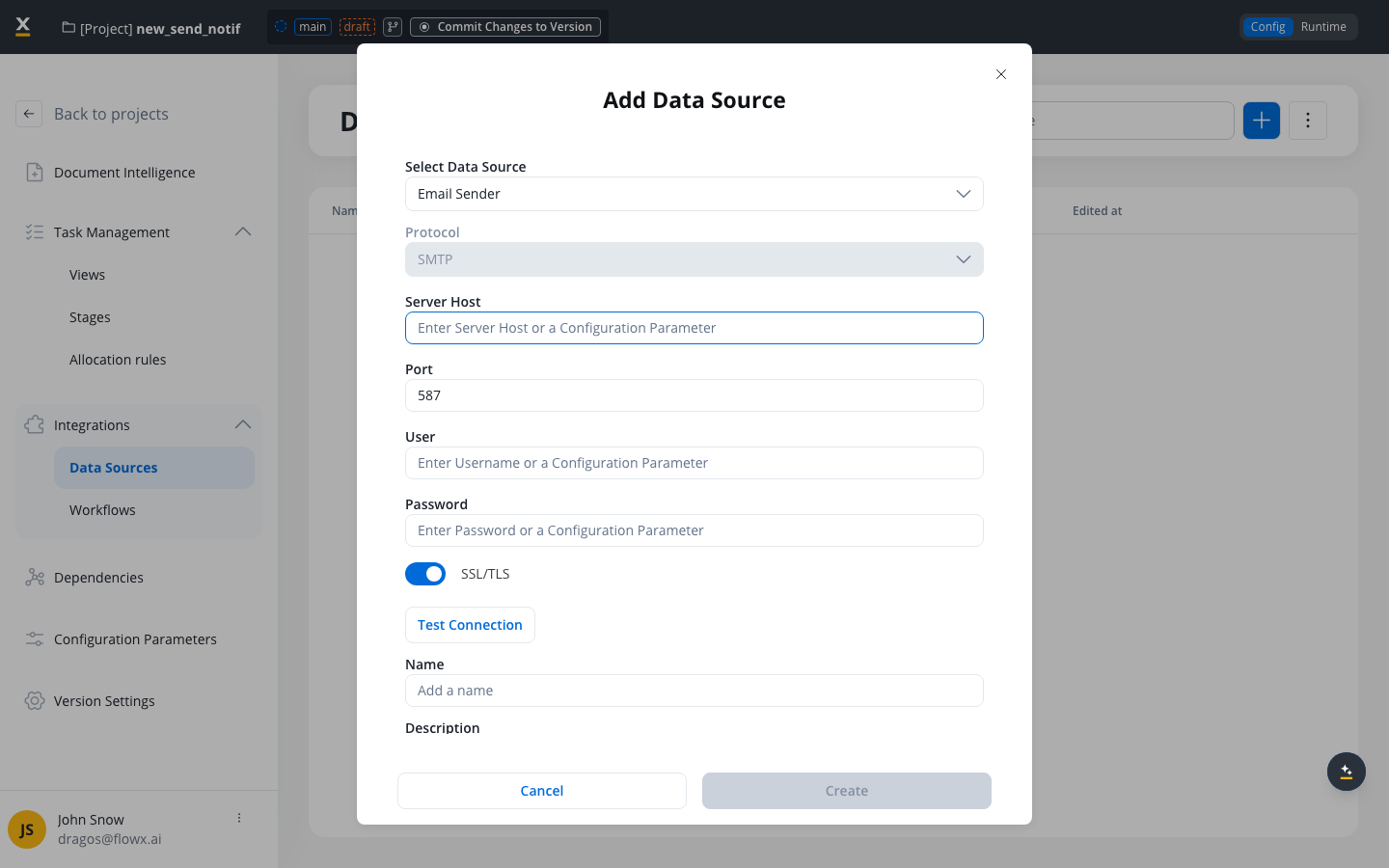
Email Sender is a data source type in Integration Designer that provides SMTP connectivity for sending emails from FlowX.AI processes. Combined with the [Send Notification](../../building-blocks/actions/send-notification-action) action, it enables use cases such as:
* **Replying to incoming emails**: Continue email conversation threads started by an [Email Trigger](./email-trigger)
* **Sending outbound notifications**: Send emails directly from business processes
* **Customer communication**: Automated responses, confirmations, and follow-ups
Email Sender handles **outbound** SMTP connections for sending emails. For **inbound** IMAP connections that trigger processes when emails arrive, see [Email Trigger](./email-trigger).
***
## How it works
Configure an SMTP connection in Integration Designer with your mail server credentials.
Select the Email Sender in a notification template's **Email Sender** field.
Add a [Send Notification](../../building-blocks/actions/send-notification-action) action to a process node and select the notification template.
When the action executes, the email is sent directly through the configured SMTP server.
***
## Creating an Email Sender data source
### Prerequisites
Before configuring an Email Sender, ensure you have:
* Access to Integration Designer with appropriate permissions
* SMTP server credentials (host, port, username, password)
### Access Integration Designer
Navigate to **FlowX Designer** → **Your workspace** → **Projects** → **Your project** → **Integrations** → **Data Sources** and click the **+** button to open the **Add Data Source** dialog.
### Configuration fields
Select **Email Sender** from the **Select Data Source** dropdown. The dialog displays all configuration fields in a single view:
The email protocol to use. Only **SMTP** is available for Email Sender data sources.
The hostname or IP address of your SMTP server.
**Placeholder:** "Enter Server Host or a Configuration Parameter"
**Examples:**
* `smtp.gmail.com`
* `smtp.office365.com`
* `mail.yourcompany.com`
This field accepts configuration parameters. Use `${configParam}` syntax to reference environment-specific values.
The port number for the SMTP connection. The default value updates automatically based on the SSL/TLS setting.
| SSL/TLS | Default Port |
| ------- | ------------ |
| ON | `587` |
| OFF | `465` |
The email account username or full email address used for authentication.
**Placeholder:** "Enter Username or a Configuration Parameter"
This field accepts configuration parameters for environment-specific credentials.
The password or app-specific password for the email account.
**Placeholder:** "Enter Password or a Configuration Parameter"
For Gmail and other providers with two-factor authentication (2FA) enabled, you may need to generate an app-specific password.
Store sensitive credentials in configuration parameters and reference them here using `${configParam}` syntax.
Turn on secure connection using SSL/TLS encryption. **Recommended: on.**
Toggling SSL/TLS updates the default port value automatically.
### Test the connection
Click the **Test Connection** button to verify your settings before creating the data source:
| Result | Message | Action |
| --------- | -------------------------------- | ------------------------------------- |
| ✅ Success | "Established connection" | Proceed to set name and create |
| ❌ Error | "Failed to establish connection" | Check credentials and server settings |
When you click **Create**, another authentication test is performed. If the test fails, you'll be redirected to the **Authorization** tab with an error message, but the Email Sender will still be created.
### Name and description
A unique, descriptive name for the Email Sender.
**Placeholder:** "Add a name"
**Validation rules:**
* Required field
* Must be unique within the project
* Only letters, numbers, and these characters allowed: `[]`, `()`, `.`, `_`, `-`
* Minimum 3 characters, maximum 50 characters
* Cannot be "Default Server" (this is a reserved name)
The name "Default Server" is reserved for the environment-level default SMTP connection and cannot be used. If entered, you will see the error: *"Default Server" is a reserved name and cannot be used.*
Optional description explaining the purpose of this Email Sender.
**Placeholder:** "Add a description"
Click **Create** to save the Email Sender data source.
***
## Using with notification templates
After creating an Email Sender data source, you can link it to notification templates:
1. Open a notification template in **Notification Templates**
2. Set **Email Server** to **Predefined Email Connection**
3. In the **Email Sender** field, select your Email Sender data source (or leave as **Default Server** to use the environment-level default)
For more details, see [Managing notification templates](../core-extensions/content-management/notifications-plugin/managing-notification-templates).
***
## Troubleshooting
Common causes:
* **Incorrect credentials**: Verify username and password
* **Wrong port**: Use `587` for SMTP with SSL/TLS, `465` without
* **Firewall**: Ensure outbound connections to the SMTP server are allowed
* **2FA enabled**: Generate an app-specific password for the email account
Check:
1. Is the Email Sender linked to a notification template?
2. Is the notification template's **Email Server** set to **Predefined Email Connection**?
3. Is the [Send Notification](../../building-blocks/actions/send-notification-action) action configured correctly on the process node?
4. Review process instance logs for error details
The name "Default Server" is reserved for the environment-level default connection. Choose a different name for your Email Sender data source.
***
## Related resources
Configure the Send Notification action to send emails from process nodes
Configure IMAP connections to trigger processes from incoming emails
Connect to Outlook via MS Graph API for reading and sending emails
Create and manage email and SMS notification templates
Learn about data source types and integration workflows