

- Timer Start Event: This node initiates a process instance at a scheduled time. It allows you to set a specific date or a repeating cycle for the process to start, so a process can be triggered once or repeatedly.
- Timer Intermediate Event: This node introduces time-based triggers within a process. It’s used to pause the process execution until a specified time duration or date is reached. Once triggered, the process continues its execution.
- Timer Boundary Event (interrupting/non-interrupting): Attached to a task or subprocess, this node monitors the passage of time while the task is being executed. When the predefined time condition is met, the boundary event triggers an associated action, interrupting or non-interrupting the ongoing task or subprocess.
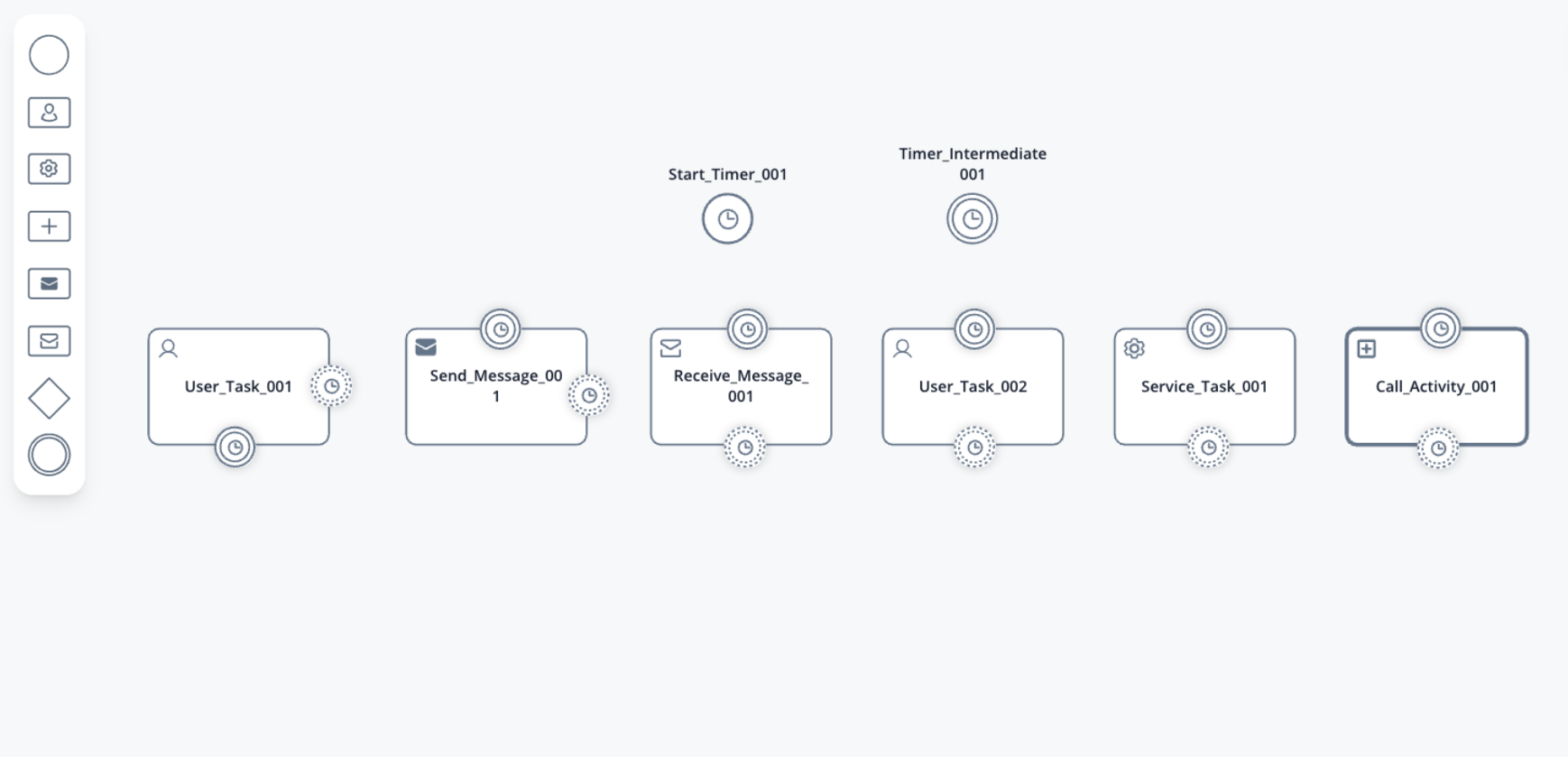
Timers
Timers introduce the ability to trigger events at specific time intervals. They can be configured in three different ways: as a date, a duration, or a cycle. These configurations can use static values or dynamic values read from the process data.-
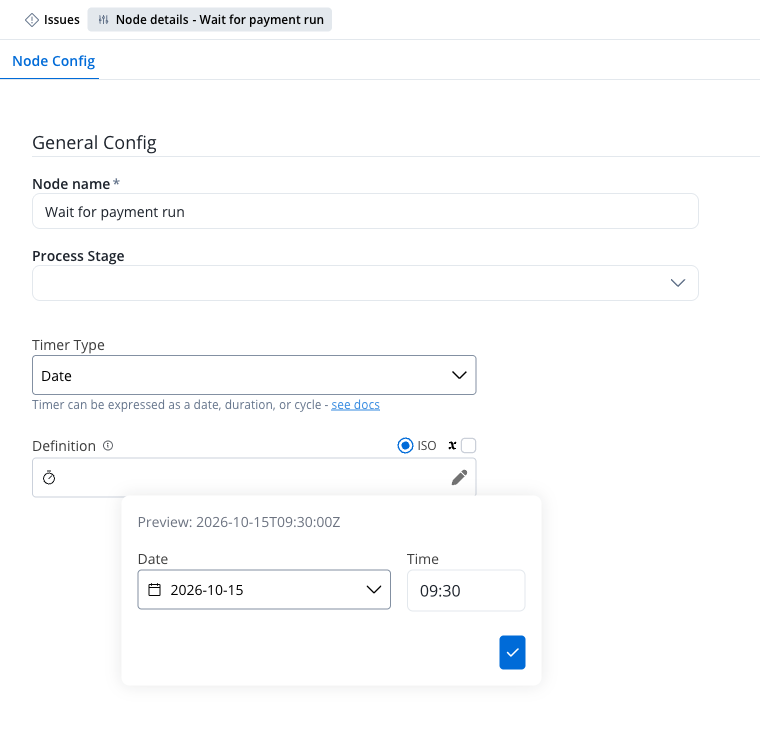
Date: Events triggered on a specific date and time.
- Format: ISO 8601 (e.g.,
2019-10-01T12:00:00Zor2019-10-02T08:09:40+02:00). Seconds and a time zone (Zor an offset) are required.
- Format: ISO 8601 (e.g.,
-
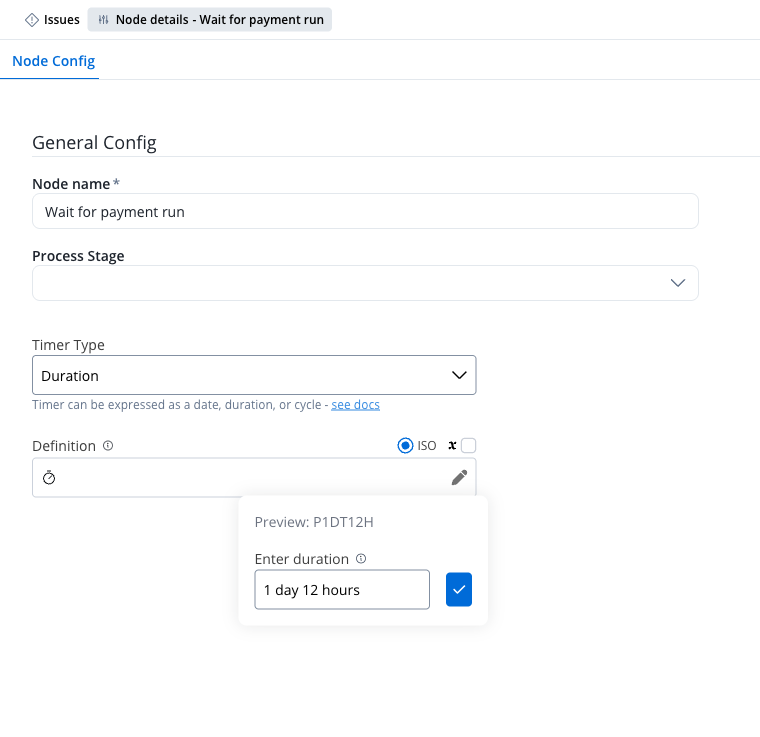
Time Duration: Events triggered after a specified duration.
- Format: ISO 8601 duration expression (
P(n)Y(n)M(n)DT(n)H(n)M(n)S)- P: Duration designator
- Y: Years
- M: Months
- D: Days
- T: Time designator
- H: Hours
- M: Minutes
- S: Seconds
- Format: ISO 8601 duration expression (
PT15S- 15 secondsPT1H30M- 1 hour and 30 minutesP14D- 14 daysP3Y6M4DT12H30M5S- 3 years, 6 months, 4 days, 12 hours, 30 minutes, and 5 seconds
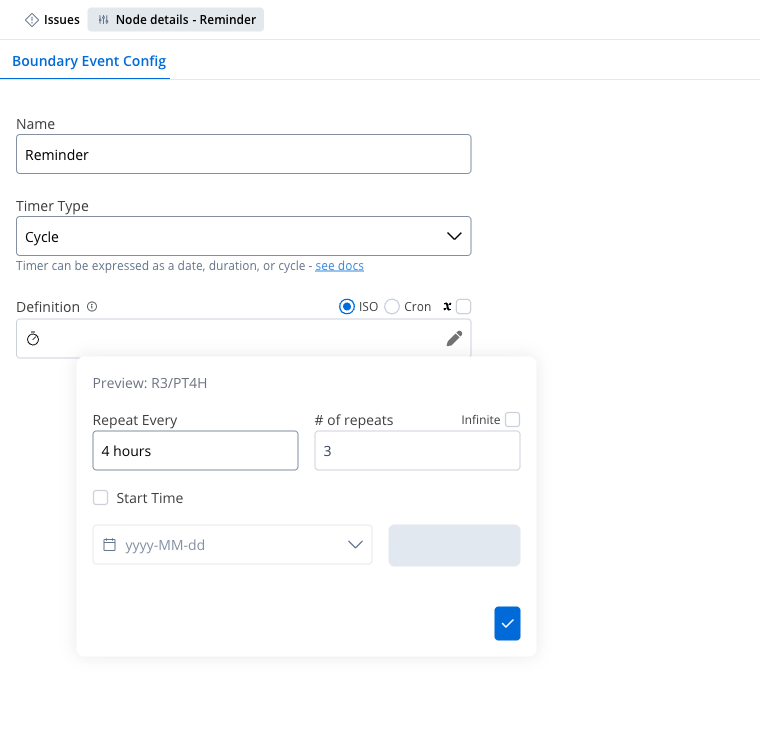
- Time Cycle (available for Timer Start Events and non-interrupting Timer Boundary Events): Events triggered at repeating intervals.
- Option 1: ISO 8601 repeating intervals format (
R)- Examples:
R5/2023-08-29T15:30:00Z/PT2H: Every 2 hours, up to five times, starting with 29 August, 15:30 UTC timeR/P1D: Every day, infinitely
- Examples:
- Option 1: ISO 8601 repeating intervals format (
- Option 2: Using cron expressions
- Example:
0 0 9-17 * * MON-FRI: Every hour on the hour from 9 a.m. to 5 p.m. UTC, Monday to Friday
- Example:
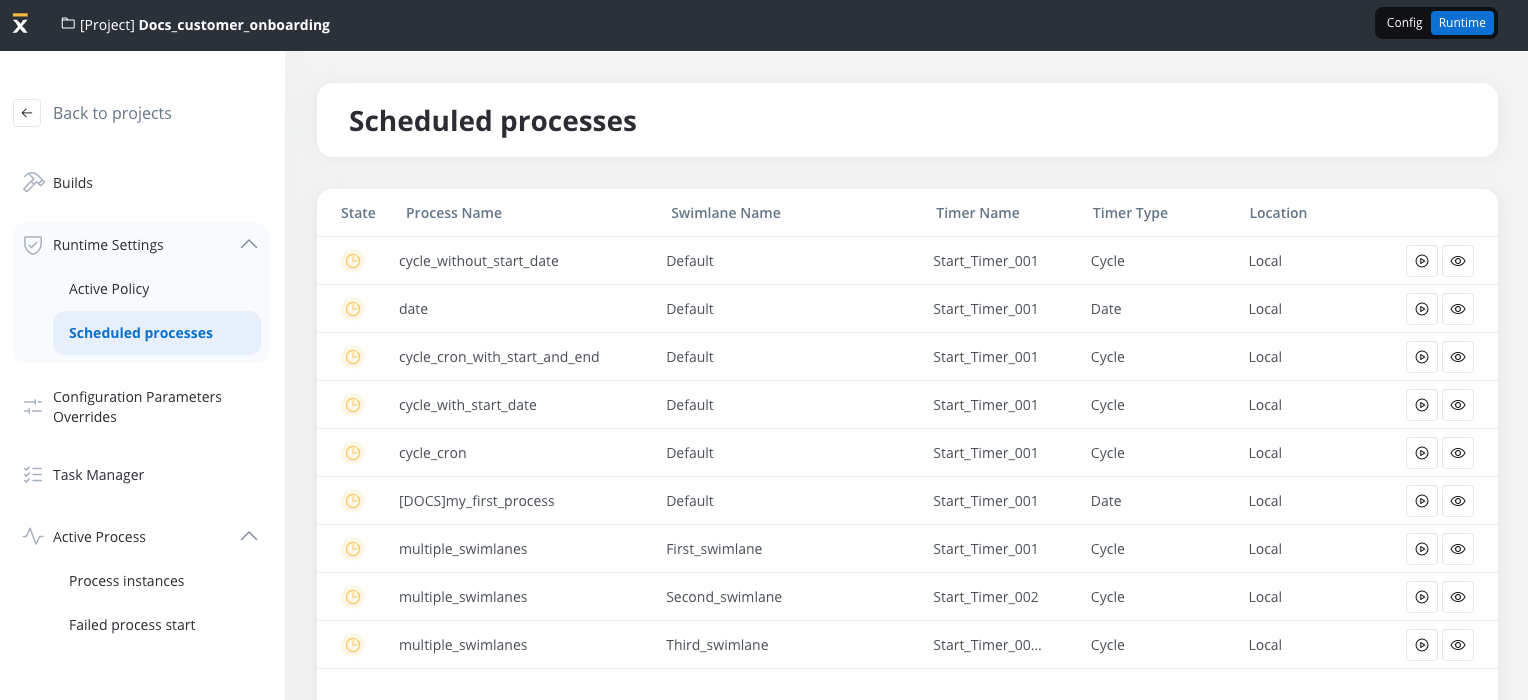
Scheduled processes
Configure a timer
Select a timer node on the canvas (or a timer boundary event on its parent activity) to open its configuration panel. The panel has the following fields:
An invalid definition is rejected with the message Invalid format. before the node can be saved.
How does the timer editor work on SaaS?
SaaS · 6.0Available on SaaS with FlowX.AI 6.0. This feature is live on managed (SaaS) deployments now. Self-hosted deployments will receive it with the next LTS release family.
- Guided (labelled Static for Duration timers) builds the value from fields: a Fire at date and time picker for Date timers, a plain-language length such as
1h30mfor Duration timers, and Repeat Every, # of repeats or Infinite, and Start Time for ISO Cycle timers. - Expression takes the ISO 8601 or cron value as typed. It is offered for Duration and Cycle timers.
- Process variable reads the value from a process data key, picked in Parameter name. It is offered on Timer Intermediate Events and Timer Boundary Events.
Timers saved with the date and time pickers in the earlier editor stored your local time marked as UTC. The SaaS editor shows a stored value converted to your local time, so such a timer can look shifted by your UTC offset. The stored value, and the time the timer fires, don’t change until you edit the timer.
Configuration
For each node type, the following timer types can be configured:
For comprehensive details on each timer event node in this section, please refer to the corresponding documentation: