> ## Documentation Index
> Fetch the complete documentation index at: https://docs.flowx.ai/llms.txt
> Use this file to discover all available pages before exploring further.
# AI providers and model configuration
> Configure AI providers and assign default and fallback models per workspace type for text generation, image understanding, embeddings, and document processing.
## Overview
FlowX supports configuring AI providers at three levels:
* **Organization level**: Add and manage AI providers, set API keys, whitelist specific models
* **Organization level (per workspace type)**: Assign default and fallback models for each AI capability, scoped by workspace type (Sandbox, Staging, Production)
* **Node level**: Override the default model on individual workflow nodes
Organization admins define which providers and models are available, and configure model assignments per workspace type. Workflow designers can optionally override the model on individual AI nodes.
***
## Organization-level: Model providers
Access model providers from **Organization Settings** → **AI Settings** → **Model Providers**.
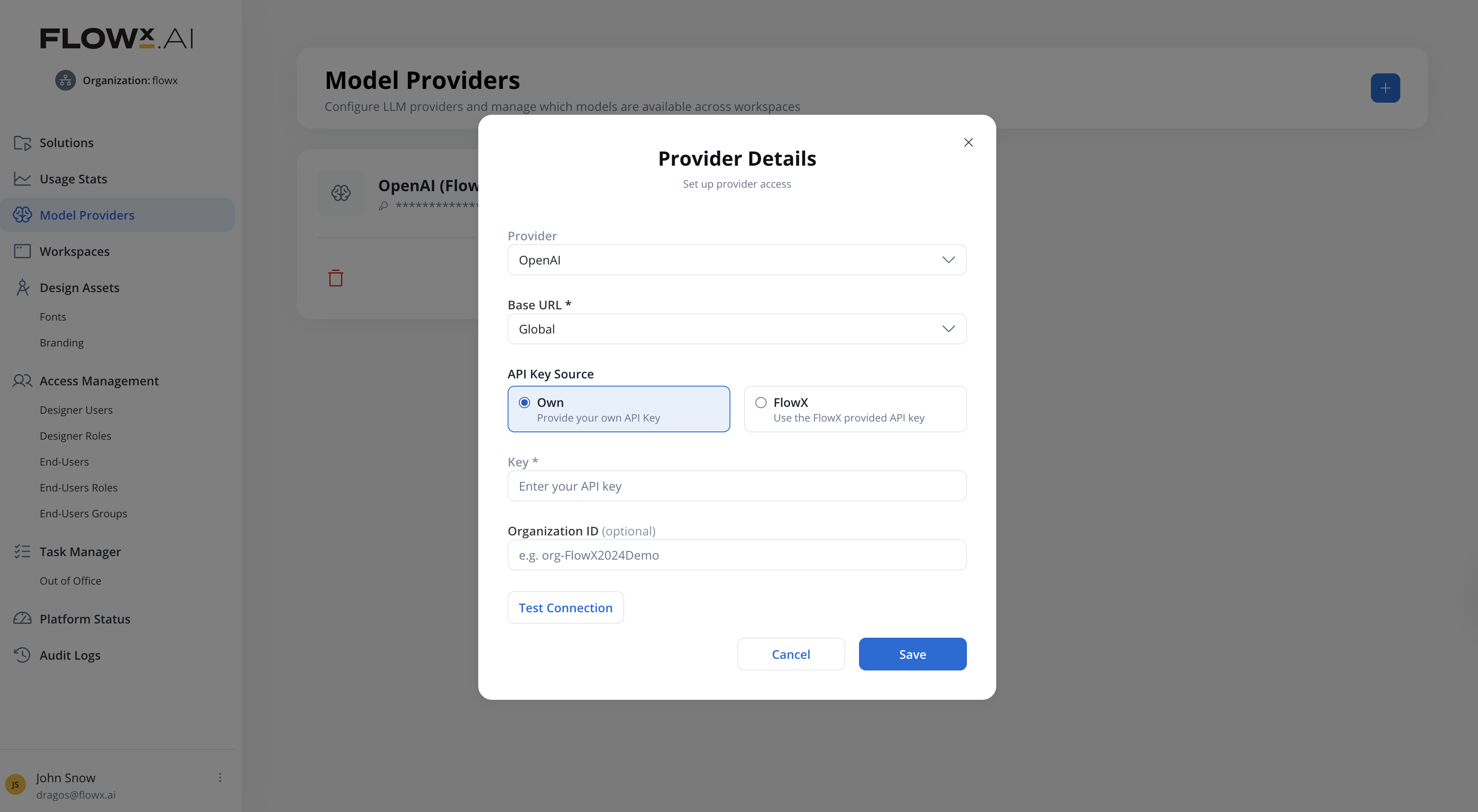
An **OpenAI** provider card is present by default, using a FlowX-managed key. You can switch it to your own key or add additional providers.
### Adding a provider
In FlowX Designer, go to your organization settings and select **Model Providers**.
Click the **+** button to open the **Provider Details** dialog. Configure:
| Field | Description |
| ------------------- | --------------------------------------------------------------------------------------------------------------------------------- |
| **Provider** | Select from the provider catalog (e.g., OpenAI) |
| **Base URL** | API endpoint (required). OpenAI offers presets (Global, EU, US) or select **Custom URL** to enter any OpenAI-compatible endpoint. |
| **API Key Source** | Select **Own** to provide your own API key, or **FlowX** to use the FlowX-provided API key |
| **Key** | Your provider API key (required, shown when **Own** is selected) |
| **Organization ID** | Provider organization ID (optional) |
You cannot add the same provider type twice. The system validates against the provider catalog and shows an error if a duplicate is attempted.
Click **Test Connection** to validate your credentials against the provider API.
* **Success:** "Connection successful. X models discovered."
* **Failure:** Error details are shown (e.g., invalid API key for 401, insufficient permissions for 403).
You cannot save the provider configuration until the connection test succeeds.
After saving, click **Manage Models** to open the model whitelisting modal. Enable specific models from the discovered list. Only enabled models appear in workspace-type assignments (Sandbox, Staging, Production).
### API Key Source
The **API Key Source** radio buttons control how the provider authenticates:
| Option | Description |
| --------- | ------------------------------------------------------------------------------------------------------------ |
| **Own** | Provide your own API Key. You have full control over the key, Organization ID, and which models are enabled. |
| **FlowX** | Use the FlowX-provided API key. The Key and Organization ID fields are hidden and cannot be edited. |
When editing the OpenAI provider, switch between **Own** and **FlowX** under API Key Source.
### Model whitelisting
The model whitelisting modal (opened from **Manage Models**) lets you control which discovered models are available downstream. Models are grouped by capability:
| Category | Description | Example models |
| ------------------- | ---------------------------------------------------------- | ---------------------------------------------- |
| **Text Generation** | Text responses, summaries, translations, extraction | gpt-4o, gpt-4o-mini, gpt-4-turbo |
| **Code Generation** | Automated code generation for Developer Agents | gpt-4o, gpt-4o-mini |
| **Embeddings** | Vector representations for knowledge base indexing and RAG | text-embedding-3-large, text-embedding-3-small |
| **Speech to Text** | Audio transcription for the Speech to Text workflow node | whisper-1 |
Each model row shows: model name, capability badges, context window (e.g., "128K tokens"), and indicative pricing (e.g., "$5 / $15 per 1M tokens").
* Use **Search** to filter models by name
* Use **Select All** / **Deselect All** for bulk actions
* A counter at the bottom shows "X of Y models enabled"
* Click **Save Whitelist** to persist your selection
Disabling a previously enabled model shows a warning listing where that model is currently used (workspace defaults, fallback assignments). Disabling it causes affected configurations to fall back to their fallback model.
Model whitelisting is not available when using the FlowX-managed key for OpenAI.
### Editing a provider
When editing an existing provider (API key or Organization ID changed):
1. The **Save** button is disabled after any field edit
2. Click **Test Connection** to validate the new credentials
3. On success, **Save** becomes enabled
4. If the newly discovered model list differs from the previous one:
* New models are added to the whitelist automatically
* If any previously enabled models are no longer available, a replacement wizard guides you through selecting alternatives
* Skipping the wizard removes the missing models from all dropdowns where they were used, and the fallback mechanism activates
### Deleting a provider
All providers except the default OpenAI (FlowX-managed) can be deleted. Deleting a provider:
1. Shows a confirmation with the impact: nodes and knowledge bases using this provider's models switch to their fallback model
2. If the fallback model is also from the deleted provider, a warning indicates that all LLM-related activities using those models will fail
### Provider card
Each provider card shows:
* Provider name and icon
* Masked API key (last 4 characters visible, e.g., `••••••••••••1234`)
* Model count: "Models enabled: X / Y"
* Organization ID (if configured)
* Connection status
* Available actions: **Manage Models**, **Edit**, **Delete**
***
## Defaults & Fallbacks
Access model assignments from **Organization Settings** → **AI Settings** → **Defaults & Fallbacks**.
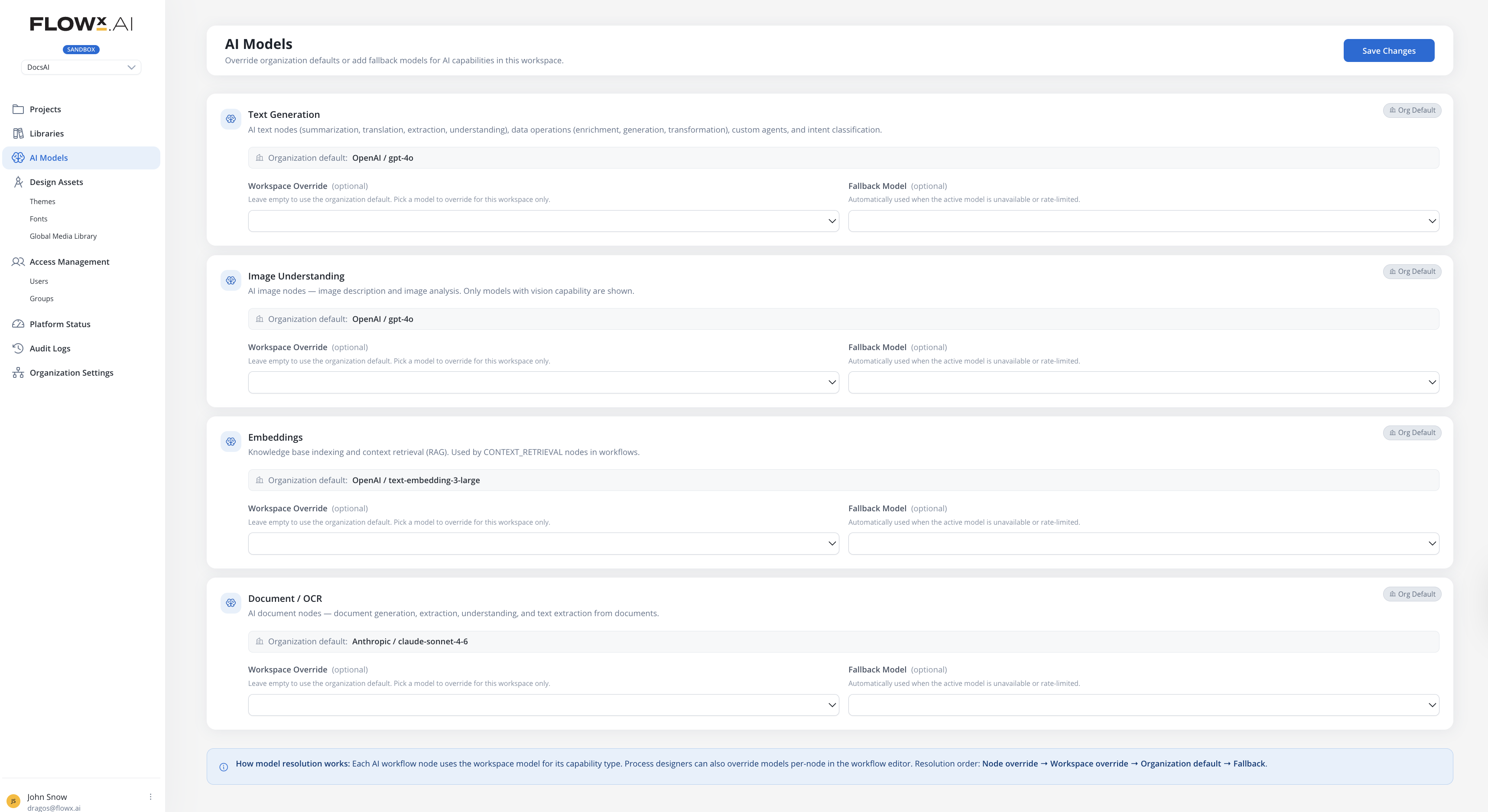
Organization admins assign a **Default Model** and an optional **Fallback Model** for each AI capability, scoped by **workspace type**. Use the **Sandbox**, **Staging**, and **Production** tabs to configure different model assignments per environment. Select **Use provider default** to inherit the catalog default for that capability.
| Capability | Used for |
| ----------------------- | ------------------------------------------------------------------------------------------------------------------------------------------------------------------------------------------------------------------------------------- |
| **Text Generation** | Text operations (summarization, translation, extraction), data operations (enrichment, generation, transformation), custom agents, and intent classification |
| **Image Understanding** | AI image nodes — image description and image analysis. Only models with vision capability are shown. |
| **Embeddings** | Knowledge base indexing and context retrieval (RAG). Used by context retrieval nodes in workflows. |
| **Document / OCR** | AI document nodes — document generation, extraction, understanding, and text extraction from documents. |
| **Developer Agents** | AI planner, developer, analyst, and designer agents. Used for automated code generation and analysis workflows. For best performance, this capability uses the FlowX tested and optimized model configured at the organization level. |
| **Audio Capabilities** | Speech-to-text transcription. Used by the Speech to Text workflow node. |
Default models from the OpenAI FlowX key are pre-assigned for each capability.
### Assigning models
For each capability:
1. Select a **Default model** from org-whitelisted models matching that capability, or use the **provider default**
2. Optionally select a **Fallback model**, used if the default model is unavailable or rate-limited
Assignments are configured per workspace type (Sandbox, Staging, Production). All workspaces of a given type inherit the same model assignments.
If the default and fallback models use the same provider, a warning is displayed. Using different providers for default and fallback improves resilience against provider outages.
When **Use provider default** is selected, the assignment inherits the catalog default model. Changes to the catalog default automatically propagate.
***
## Fallback behavior
When a primary model is unavailable, rate-limited, or disabled at the organization level, the system automatically switches to the configured fallback model. The resolution order is:
1. **Node-level override** (if configured) → its fallback model
2. **Workspace default** → its fallback model
3. **Error** if all options exhausted
| Scenario | Behavior |
| ------------------------------------- | ---------------------------------------------------------------------------------------------------------------------------------------- |
| Primary model unavailable | Fallback model is used automatically |
| Node override model not found | Falls back to workspace default model |
| API key expired or revoked | Nodes using this provider's models fail with "API key invalid" in the execution log. Provider shows a warning at the organization level. |
| Both primary and fallback unavailable | Node fails with error: "Primary and fallback models unavailable. Contact your organization admin." |
***
## Per-node model override
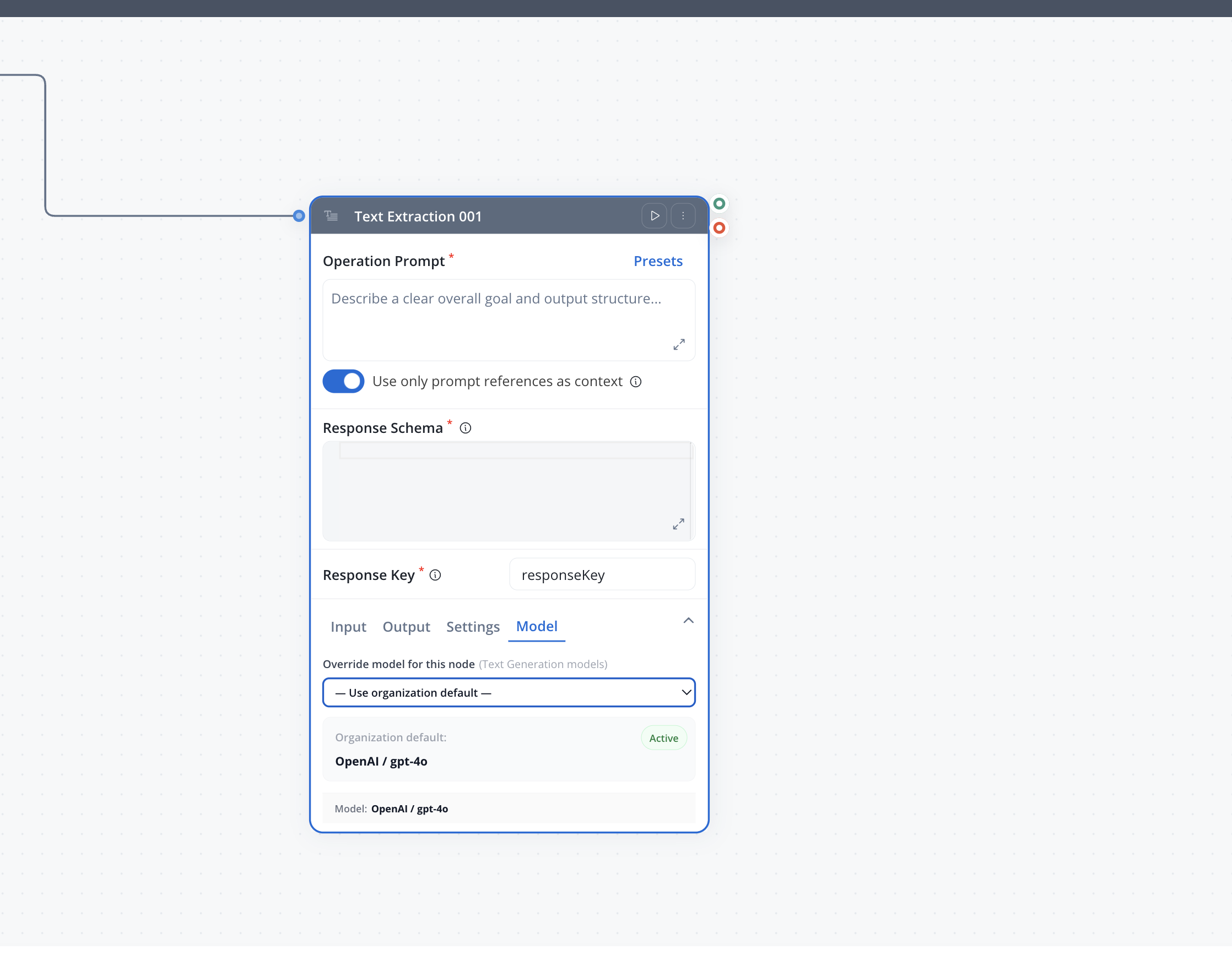
Workflow designers can override the default model on individual AI nodes (Custom Agent, Intent Classification, etc.) in the Integration Designer. This allows different nodes in the same workflow to use different models. For example, a fast model for intent classification and a more capable model for complex reasoning.
### How it works
When configuring an AI node, an optional **Model Override** section lets you select a specific model:
| Field | Description |
| -------------------------- | -------------------------------------------------------- |
| **Provider type** | The provider to use (e.g., `OPENAI`) |
| **Model** | The specific model (e.g., `gpt-4o`) |
| **Fallback provider type** | Optional fallback provider if the primary is unavailable |
| **Fallback model** | Optional fallback model |
The override uses portable identifiers (`providerType` + `modelIdStr`) that resolve at runtime against the organization's available models. Only models enabled in the organization's whitelist can be selected.
When no override is set, the node uses the workspace default model for its capability (text generation, embeddings, etc.).
Per-node model overrides apply to the **text generation** capability only. Other capabilities (image understanding, embeddings, document/OCR) always use the workspace defaults.
***
## Supported providers
FlowX maintains a provider catalog with pre-configured provider types. Each provider type includes display metadata (name, icon) and optional base URL presets.
| Provider | Key mode | Notes |
| ---------- | --------------------- | ----------------------------------- |
| **OpenAI** | FlowX Managed or BYOK | EU, US, and Global base URL presets |
***
## Permissions
| Permission | Description |
| ----------------------- | ---------------------------------------------------------------------------------------- |
| `org_ai_providers_read` | View AI providers and model assignments at organization level |
| `org_ai_providers_edit` | Add, edit, delete providers, manage model whitelists, and configure Defaults & Fallbacks |
***
## Related resources
Overview of AI capabilities in the FlowX platform
Build AI agents that use the configured models
Create chat experiences powered by AI models
Manage organization-level settings